Friday, April 22, 2011

"A Little Dictionary of Eight Languages"

Today's post highlights one of my favorite early printed books in the Center's collection, an eight-language pocket "dictionary" which presents itself as a series of formal dialogues. While books without unique manuscript content or provenance are typically not the subject of this blog, this "little Dictionary of eight languages" is simply too wonderful to ignore.  


New Dialogues or colloquies, and, a little Dictionary of eight Languages [...]
London: Printed by E[dward]. G[riffin]. for Michael Sparke, junior [...], 1639.
STC 1432
contemporary calf binding, rebacked

This printed language aid is based on the work of Noël de Berlemont (d. 1531), who wrote a dictionary and series of Flemish-French colloquies in the sixteenth century (see catalog record). As its title page suggests this is "a booke very necessary for all those that Studie these tongues, either at home or abroad," in addition to "Travellers, young Merchants and Sea-Men, especially those that desire to attaine to the use of these Tongues." The "tongues" in question are eight in number: Latin, French, Low and High Dutch, Spanish, Italian, English, and Portuguese. The absence of Greek and Hebrew emphasize the practical (rather than scholarly) purpose of the book.

Many writers of educational treatises in the early modern period adopted the colloquy, or formal conversation, as a structuring component of their works; in fact, the Center also owns a book of Sea-Dialogues, a set of conversations between a captain and crew member that explicate numerous points of seamanship and navigation. While to the modern reader a formal, prescribed dialogue may come off as a bit of an odd method for language instruction, books like this were actually fairly common in the period and have made a lasting impact on phrasebooks ever since. The main difference between the two lies in the fact that modern phrasebooks feature only snippets of conversation rather than entire discussions and debates; the larger conversational context is left open to the vagaries of lived experience in the world. 

 New Dialogues or Colloquies, on the other hand, presents detailed conversations held among groups of hypothetical diners, travelers, merchants, etc. on subjects such as eating, shopping, asking directions, and settling debts. In the first preface "to the reader" (first image above) the author promises his dialogues have been "pleasantly, morally, and politely...penned," that he has "taken as much paines in this Schoole of Conferences or Colloquiums, as any man living," and has therefore had them "handsomely printed." (Unfortunately heavy foxing has made our copy far from "handsome.") 

The second preface to the reader (translated into eight different languages, as seen in the second image above) claims that "this Booke is so needfull and profitable, and the use of the same so necessary that its goodnesse, even of learned men, is not fully to be praised." 


The best (well, most entertaining) dialogue is entitled "A Dinner of ten persons, to wit, Hermes, John, David, Mary, Peter, Francis, Roger, Anne, Henry, and Luke." (And I have no idea why Hermes is the only hypothetical diner named after a Greek god—is he the foreigner here?) While many of the dialogue's translated phrases are commonplace enough for practical travel use, the unlikelihood of a conversation following this particular form makes the whole colloquy quite comical.

"J: Eate it not all, let that alone which ye shall have too much. 
P: Wherefore eate you not your pottage while it is hot. 
F: It is yet too hot.
M: [with a total non sequitur] John, bring here bread, Roger hath no bread, goe fetch a trencher, and bring here mustard. 
P: Give me the beere-pot.
R: Hold there, hold it well. 
P: Let it goe, I hold it well. 
M: Peter, drink not after thy pottage, for it is unwholesome: eate first a little before you drinke. Peter, cut me fleshe."

This colloquy is fairly representative of the entire book. One sees the practical use of certain phrases here and there, as did an early underliner, who has noted "while it is hot," "mustard," "beere-pot," and "after thy pottage" (in Spanish and Low Dutch). But in terms of a conversation this exchange is chaotic at best. What happened to the bread and mustard? Has Francis' pottage cooled yet? When will they give Peter a break so he can drink his beer? Clearly the formality of the colloquy as a genre doesn't preclude the conversation from devolving into a loosely connected series of phrases from time to time.

Here is more of the dinner conversation:


I particularly like (in the third  and fourth images) the exchange about the knife and eating habits:

"A: Roger, lend me your knife, I pray you.
R: Take it, but give it me againe when you have eaten.
A: If I give it not you againe, lend it me no more.
R: No indeed.
A: It is a good knife, how much hath it cost you?
R: It hath cost me six pence.
A: It is good cheape: let me have it for that same price, I will give you your money againe.
R: I am content.
[And then Mary, out of nowhere]
M: Roger, you eat nothing [maybe because he lent out his knife?], me thinke that you are ashamed, helpe your selfe, are you ashamed?
R: Doe I not eate well? I eate more than any man that is at the table.
M: That you doe not.
A: You eate nothing yourselfe.
M: I have well eaten. 
P: [in a diplomatic gesture] Let us drincke well, if that we have ill to eate."
 

Tuesday, April 19, 2011

Bookplates and Provenance III

Today's post highlights a few more bookplates from the Center's rare book collection. As in similar entries about provenance, I have attempted to track down the people associated with these bookplates and provide you with a bit of information about their lives.

Sir John Vanbrugh, Plays, 2 vols. [Center owns v. 1 only]
London : Printed for J. Tonson, and J. Watts; and for J. Darby, A. Bettesworth, and F. Clay; in trust for Richard, James, and Bethel Wellington, MDCCXXX [1730]. 
Contemporary calf, 12mo
  
Here we have an early twentieth-century plate depicting a pastoral scene. The bookplate was designed by Edwin Davis French (1851-1906), one of the most important bookplate designers of the nineteenth century. This plate is signed 1906 (I think, it may read "1900"), and considering its late date it is likely this is one of the last plates French designed. 

"Nathan T. Porter, Jr." is most likely Nathan Todd Porter, Jr., a New York businessman born in Brooklyn on December 5, 1867. He attended high school in Montclair, NJ, and graduated from Yale in the class of 1890. According to the 1907 edition of Who's who in New York City and State, Porter was a "dry goods commission merchant," and ran the firm Porter Brothers and Company with his brother Thomas Wyman Porter. 
 
The Elizabeth Club at Yale University owns several early printed playbooks with Porter's bookplates. See Stephen Parks, The Elizabethan Club at Yale University and its Library (New Haven: Yale University, 1986), 51, 74, 82, 108, 117, 120.


Boethius, De consolatione philosophiae.
Lugduni Batavorum [Leiden]: Ex officina Hackiana, Ao. M D C LXXI [1671].
Contemporary full vellum binding.

This bookplate and inscription belong to Augustus Montague Summers 
(1880-1948),an eccentric Englishman who wrote on subjects as various 
as the occult and Restoration drama. The signature dates from his youth:
in 1899 he entered Trinity College, Oxford, where he received two degrees
(B.A.1905; M.A.1906). The bookplate (signed by an unidentified "J.W.") 
probably dates to this early part of Summers' life as well, since we know
of a later bookplate reading "Alphoinvs Montagve Svmmers Liber svvs" 
(designed by Eric Gill)—Alphonsus being a name in religion Summers' used
after 1910 when he received a clerical tonsure from the Church of Rome
(Davies, ODNB). 

In fact, the ODNB article on Summers' is quite an interesting read. His
career in the Anglican Church was cut short around 1908, when 
"rumours of studies in Satanism and a charge of pederasty" became 
associated with his name. He wrote a number of books on vampires, 
demons, and werewolves. His activities as a literary critic are well
known (he published a history of the gothic novel in 1938), and his
work on English Restoration drama is particularly important 
(including a six-volume Works of Aphra Behn).

Pierre de la Primaudaye, Academie Francoise


A Paris : Chez la vefue Claude de Monstr’oeil, ruë S. Iean de Latran, & en sa 
boutique en la Court du Palais au Nom de Iesvs, M. DC. X [1610]. 
Contemporary limp vellum binding

The Latin quote on this bookplate is from Lucretius, De rerum natura,
Book I, ll. 927-8. In the Rolfe Humphries translation of 1968, the lines
read: "I come to fountains / Completely undefiled, I drink their waters, /
Delight myself by gathering new flowers." The lines metaphorically link
flowers, clear fountains (of the muses), and, of course, books.

Katherine Theresa Butler (1883-1950) wrote a two-volume History of 
French Literature (London: Methuen, 1923), and at the time of its 
publication was Director of Studies in Modern and Medieval Languages
at Girton College, Cambridge.

Tuesday, April 5, 2011

Early Printed Maps

In anticipation of my talk next week (4/13) on "Early Printed Maps," today's post highlights several of our collection's cartographic items. Time is a bit short for me this week (SAA in Seattle), so today's entry is heavy on images and light on text.

"Angliae Heptarchia" from William Lambarde, A Perambulation of Kent (1596)
"Bedford" by Christopher Saxton (1610?)
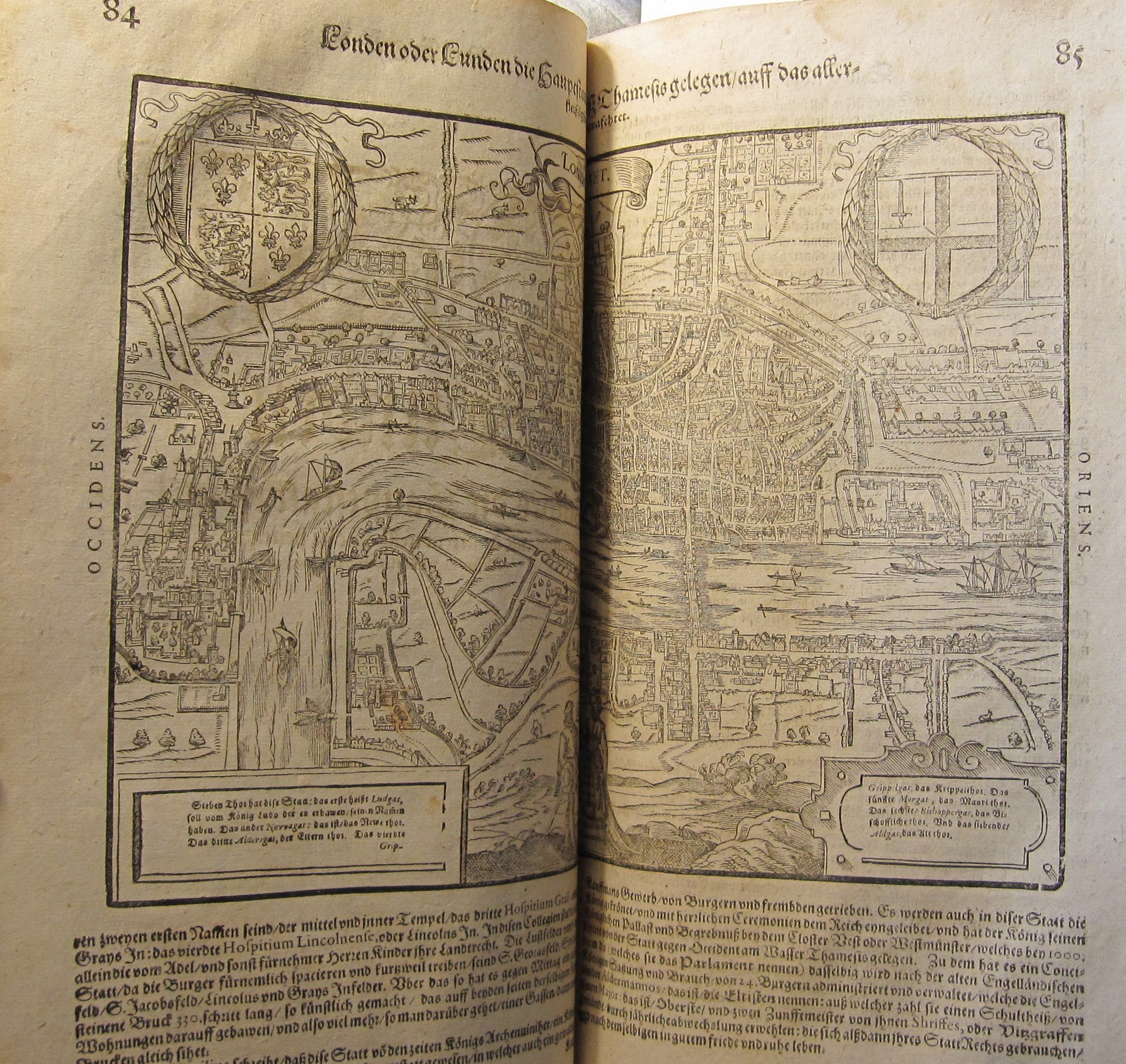
Map of London from Sebastian Münster's Cosmographia (1628)
Europe as Map/Monarch, from Sebastian Münster's Cosmographia (1628)
World Map from Sebastian Münster's Cosmographia (1628)
"The description of the holy Land" from [The Bishop's Bible] (1602)
"Africae Descriptio Nova" from Peter Heylyn, Cosmography (1670)
"Americae Descriptio Nova" from Peter Heylyn, Cosmography (1670)

Friday, April 1, 2011

"Madam St. Andrew," a Royal visit to Wolverhampton, and Manuscript Clues in Printed Books

According to an anecdote from Wolverhampton (Staffordshire, West Midlands) local history, King Charles I visited the city in 1643 shortly after the Battle of Hopton Heath (19 March 1642/3). There the king stayed at a private residence, where he "was entertained by Madam St. Andrew, a near connection of Mr. Gough" (Burke, Genealogical and Heraldic History, II.393). According to Stebbin Shaw, this "Madam St. Andrew" was "either sister or aunt to Mr. Henry Gough" (History and Antiquities of Staffordshire), a prominent local landowner and Royalist. For the rest of the anecdote I direct you to Burke. But to summarize it briefly, it appears that Henry Gough publicly denied the King any financial support for his military campaign, only to visit him privately at night (much to the alarm of the King's guards) with a large monetary gift (£1200 according to Burke's note). Charles was apparently so impressed with the gift that he proffered to knight Gough, who politely and humbly declined this signal honor. 


So what is the connection between this anecdote and our collection of rare books? The answer lies in the mysterious identity of this "Madam St. Andrew," who may have owned one of the books in our collection. 

(As a side-note, the house she lived in while harboring the king would become an inn—the "Star and Garter"—in the eighteenth century. See this page for more on the "Star and Garter.")

John Speed, The historie of Great Britaine under the conquests of the Romans, Saxons, Danes, and Normans. Their originals, manners, habits, warres, coines, and seales, with the successions, lives, acts, and issues of the English monarchs from Julius Caesar, unto the raigne of King James, of famous memorie
At London: Printed by John Dawson [and Thomas Cotes], for George Humble, 1632. 
[22], 1042 p., 1043-1086 numb. ℓ., 1087-1237, [85] p.  illus., geneal. tab. (port.)  35 cm (folio). 

One of our two copies of Speed's Historie contains several interesting marks of seventeenth-century provenance. The first seems to read "Henry Syrott" [?], but I have been unable to identify him.

The next one seems to allude directly to the anecdote about "Madam St. Andrew," the Goughs, and Charles I cited above.

"John Goughe his booke,
given him by his Aunte:
mrs Elyzabeth St andrewe"

According to Shaw, "Madam St. Andrew" was either the sister or aunt of Henry Gough, who was the father of John Gough (his ownership inscription is possibly shown here). The signature of "Elizabeth St. Andrew" appears at the rear of the volume on a strip of vellum used to reinforce the binding.


If this is in fact the same "Madam St. Andrew" who was "sister or aunt" to the Henry Gough in the above anecdote, then John Gough's ownership inscription seems to establish that she was in fact his aunt, and therefore Henry's sister. 

On one of the rear endpapers someone transcribed (in a careful italic hand) part of Francis Quarles's epigram "On Fox" (i.e. John Foxe, writer of the Protestant martyrology Actes and Monuments--major edns. in 1563, 1570, 1576, and 1583). According to the Folger First Line Index, this poem appears in only two other places: Quarles's Divine Fancies (1641; Wing Q62, p. 101) and BL Harley 2311, f. 20. The version of the poem transcribed here (probably in Elizabeth St. Andrew's hand) is missing the last two lines:


Transcription: 

there was a tyme woe worth that heavye tyme
when wolvish foxes did devour the prime
and choyce of all our lambs. but heaven did raise
a most ingenious foxe in after dayes
whose high immortall penn redeemd their breath
and made there names to live in spight of death

The last two lines (present in both Divine Fancies and the Harley MS) read:

To see, how mutuall Saintly favors be!
Thou gav'st them life, that now give life to thee.

There are other interesting variants between the printed poem in Divine Fancies and the transcribed fragment shown here. The printed version reads "rav'nous foxes" for "wolvish foxes" and "made those lambs revive" for "made there names to live." Since the ms version doesn't contain the final two lines, I doubt Elizabeth St. Andrew copied the poem from Quarles's printed book; I think it is likely she copied it from another manuscript source. 

Coincidentally, the city of Wolverhampton opens an exhibit on its royal visitors tomorrow, but it doesn't mention Charles' visit in 1643.
 

Friday, March 25, 2011

Customizing Camden III

This will be the third and final post on "Customizing Camden," a multi-part series of entries I began three weeks ago that presents images and commentary on the Center's collection of annotated books written by the antiquary William Camden (1551-1623). Today I will focus on two books formerly owned by major figures in early modern England, the London stationer Humphrey Robinson and the Professor of Music at Oxford from 1661-1682, Edward Lowe. 


William Camden, Annales rerum Anglicarum et Hibernicarum regnante Elizabetha. Lug. Batauorum [Leiden]: Ex officina Elzeviriana, MDCXXV [1625]. [16], XVI, 855, [41] p. :  port. ;  18 cm. (8vo). 

Renaissance Center copy is in contemporary calf (lacks portrait); in phase box; inscription on front free endpaper: "Ex dono charissimi amici mri Humphredi Robinson Stationarij Londinensis. a. d. 1627. R.E.", and ms. initials "R.E." on title page; armorial bookplate of J. W & O. Farrer and stamp of the University of Illinois Library on front pastedown; bookseller’s description and invoice (of C.A. Stonehill) to William A. Ringler, Jr., laid in.

First published in 1615, Camden's Annales was the first biography of Queen Elizabeth I. This copy of the 1625 Elzevir edition contains not only the work's first three parts (completed in 1615), but also its fourth (completed in 1617), which Camden instructed his friend Pierre Dupuy of Leiden to publish only after his death (Herendeen, ODNB).

The book was formerly owned by "J.W. and O Ferrer," whose "die-and-sinker style" bookplate (popular in the nineteenth century) sits alongside the ink stamps of the University of Illinois (at Urbana-Champaign) library. 

While the bookplate and stamps may strike one as rather typical marks of provenance in antiquarian books, this gift inscription (on the front free endpaper) is a rarer bird, documenting the book's association with Humphrey Robinson (d. 1670), one of seventeenth-century London's most important and prolific bookseller-publishers. 

The inscription reads:

Ex dono charissimi amici Mri Hum=
phredi Robinson Stationarij
Londinensis. a.d. 1627
                                         R.E.

Translated:

From the gift of [my] dearest friend Mr. Humphrey Robinson of the London Stationers. a.d. 
1627

It may be impossible to determine who "R.E." was (I eagerly invite speculation), but the inscription nonetheless documents the gift-giving activities of an important stationer in the first few years of his full company membership (he became a freeman in 1623). Robinson's career spanned nearly fifty years (1624-1670), during which time he produced such eminent literary works as the Beaumont and Fletcher first folio (with Humphrey Moseley, 1647), John Milton's A Masque presented at Ludlow Castle [Comus] (1637), and Francis Bacon's Essays (1669). As was customary with gift inscriptions of this kind, the text here was written by "R.E.," the recipient of the gift, rather than Humphrey Robinson, the gift-giver. I believe the manuscript price ("4s") is in a different hand, and may have been a retail price associated with the London book trade. 

William Camden, The historie of the most renowned and victorious Princess Elizabeth: late Queen of England: contayning all the important and remarkeable passages of state both home and abroad, during her long and prosperous raigne: composed by way of annals: neuer heretofore so faithfully and fully published in English. 
London: Printed for Benjamin Fisher and are to be sold at his shop in Aldergate streete, at the signe of the Talbot, MDCXXX [1630]. 

[22], 138, 120, 104, [6], 105-148, 224, [20] p. :  port. ;  28 cm. (fol.)

Renaissance Center copy is in contemporary (?) calf (lacks Aaa⁴; hinges split at top; final leaf torn); signature "Ed: Lowe" on recto of pi1 and "Edwd. Lowe" on inside front cover; earlier signatures "Richard Whyting [?]" and "John [---]" on recto of pi 1 are partially obliterated in ink; ms. notes on front free endpaper, including "Second hand Cost 4s 2d" in an early hand.  

This 1630 translation of the Annales, "neuer heretofore so faithfully and fully published in English" as the title advertises, contains several interesting manuscript notes dating to the seventeenth century. 


The first of these two inscriptions (the one partially obliterated by ink) appears to read "Robert Whesting." I have been unable to identify him. The second inscription, on the other hand, belongs to Edward Lowe (c. 1610-1682), who served as Professor of Music at Oxford University from 1661-1682. His italic hand and signature survive in a number of contemporary music MSS held in UK institutions. A less stylized version of his signature, from a music manuscript at the British Library, can be seen here.


Lowe also signed the book's inside front cover. 

Perhaps the most interesting manuscript writing in this copy of The Historie of Elizabeth appears on the front free endpaper, a page bearing a number of signatures, scribbles, sums, and notes. I haven't fully worked out the manuscript notes on this page, but there seem to be at least three (probably four) different hands at work. The "Robert Whesting [?]" who signed [pi]1r seems to have begun his signature at the very top of this leaf, to the right of the sum that comes out to 15:0:5. The descender of the majuscule "R" he uses looks very similar to that of the "R" in the note reading "A Receipt" near the edge of the page (both shown below).


Near the top center of the page, in a different hand, a "John W [...]" started to sign his name. In the bottom left-hand corner of the page, in yet a different hand, is a note recording the book's second-hand price: "Second hand / Cost 4s:2d" (shown below).

Finally, in the page's messiest secretary hand (possibly by "John W."), there are a series of notes that appear to relate to someone borrowing the book. 

The annotator begins this note twice (upper center of the page)—"This vnto" and "The Co" —before committing to the substantial note in the page's right center. 

The note itself (marked by two heavily inked vertical lines) reads:

Condicion (of this obligacion)
    is such      s
                               this vnto her returne
                               I affecte as deare
                               as my owne heart
                               yet that receue 
                               mee neare                       

(Special thanks to Heather Wolfe for helping with the transcription.)

The note seems to outline a situation in which someone (probably a lover) was required to return a book to an unknown woman ("her") who the borrower "affecte[d] as deare / as [his] owne heart." This note, along with the book's other manuscript additions, afford us with brief but tantalizing glimpses at both the second-hand book trade and the social practice of book lending in early modern England.

That does it for this week's post and the "Customizing Camden" series. Hope you have enjoyed the entries.

Friday, March 11, 2011

Customizing Camden II

Continuing with the focus of last week's post, today I'll write about a few more of our copies of works written by the antiquary William Camden, all of which contain unique manuscript content added by former owners. Last week I highlighted our two copies of Camden's Remaines, especially how owners added their own manuscript epitaphs, proverbs, and apothegms to the printed book. Today's examples deal more specifically with provenance and ownership inscriptions.

Britannia, sive, Florentissimorum regnorum, Angliae, Scotiae, Hiberniae, et insularum adjacentium ex intima antiquitate chorographica descriptio. Londini: Impensis Georg. Bishop [at the Eliot's Court Press], 1590
[16] 762, [22] p. : Ill. : 19 cm. (8vo). STC  4505

Renaissance Center copy is in contemporary calf (head and foot of spine, and back hinge, torn; several leaves lacking: C1, 3D1, and 3D8); signed on rear flyleaf: "Thos Charles’s book"; a fragment of a printed (incunable?) bifolium is inside back cover, under the turn-ins; a similar fragment appears to be undeneath the (later) front pastedown; stamp on title page and p. 299 of the Theological College, Bala, noting it as from the library of the late principal, T. Charles Edwards.

The purple stamp on the title page places the book in the library of Thomas Charles Edwards (1837-1900), a Welsh minister who held the post of Principal at the University College of Wales, Aberystwyth. Dated May, 1900 (two months after Edwards' death), the stamp is associated with the "Theological College, Bala," (Bala, Gwynedd, Wales) a school that Edwards helped found. 

At an earlier point in history (probably the eighteenth century) a "Thomas Charles" owned the book, as can be seen in this manuscript inscription. 

Perhaps shortly after the book was printed, a book craftsman used a fragment of a bifolium (perhaps an incunable) to strengthen the binding. I have been unable to identify the text as of yet.


Britannia, sive, Florentissimorum regnorum, Angliae, Scotiae, Hiberniae, et insularum adjacentium ex intima antiquitate chorographica descriptio. Londini: [at Eliot's Court Press] per Radulphum Newbery, 1587. 
[16], 648, [24] p. : ill ; 17 cm. (8vo). STC 4504


Renaissance Center copy is in contemporary vellum (portion of backstrip detached, revealing ms. waste in binding; detached piece laid in at back); in phase box; several ornamental initials have been hand-colored, probably much later; signatures on title page: "Jos.a Dobson" and "Carolus [Fynn?] Anno 1771"; some random pen-trials.

This title page of this book bears two ownership inscriptions: "Jos.[eph] a. Dobson" and "Carlous [Fynn?] Anno 1771." While one cannot determine this for certain, it is likely one of these two owners hand-colored several of the book's ornamental initials.

It is unlikely this hand-coloring is contemporary, but considering the late eighteenth-century provenance on the title page it is still possible that this decoration was added several hundred years ago. The colored initials display a variety of inks and paints; I detect no fewer than seven different pigments in this capital "A" for instance. 


The "N" shown here is outlined in gold paint and bears an equal variety of pigments and inks. 

From this broader vantage point, one can see how the color really enhances the aesthetic appearance of the book. 


Unfortunately due to time constraints I will have to wait until the next post to talk about our two Camden books with the most interesting early modern provenance (related to Edward Lowe, seventeenth-century Professor of Music at Oxford University; and the London stationer Humphrey Robinson). I'll be away from the blog next week, but expect "Customizing Camden III" on the following Friday.

Friday, March 4, 2011

Customizing Camden I

As some of the period's best-selling works of English history, the printed books of the antiquary William Camden—most notably the multiple editions of Britannia (1586) and Remaines concerning Britaine (1605)—appeared in early modern bookshops with particular abundance, and have consequently survived in a relatively large number of extant copies. The Center owns fifteen copies of Camden's works printed between 1587 and 1751, including six copies of the Britannia and two each of the Remaines and Annales

Today's entry and a continuation next week highlight the numerous manuscript annotations and additions owners left behind to customize their copies of Camden's works. While the body of manuscript content found within these books is miscellaneous at best, by anchoring a study of these unique additions within the context of Camden's printed record certain patterns of use begin to emerge. Below I will discuss our two copies of Camden's Remaines and how readers augmented them with specific manuscript additions. 


William Camden, Remaines concerning Brittaine: but especially England, and the inhabitants thereof: their languages, names, syrnames, allusions, anagrammes, armories, moneys: empresses, apparell, artillerie, wise speeches, proverbs, poesies, epitaphs. London: Printed by A.I. for Symon Waterson, 1629.
[4], 9, 8-346 p. ; 19 cm. STC  4524
Renaissance Center copy is in modern half calf and brown cloth; signature "Ob: Ghossipp" on title page; some ms. annotations, including additional proverbs.

If Britannia contains the most important points of Camden's antiquarian research, the Remaines offers an overflow of information—mainly items of linguistic curiosity—collected during his extensive travels. As Wyman H. Herendeen summarizes, "[w]ith the first historically organized anthology of medieval poetry, a historical and comparative study of the English language, collections of names and their meanings, of (in the words of one of the chapter headings) ‘grave speeches, and wittie apothogemes,' and of epitaphs, it can be seen as a popular spin-off from its more expensive and serious historical mother lode, the Britannia" (ODNB). The Remaines is essentially a vast print miscellany structured around specific forms and genres, and this format may have invited readers to add their own epitaphs, poems, apothegems, proverbs, etc. 

The manuscript notes and additions in this copy (the fourth edition) were apparently written by the "Ob: Ghossipp" who signed the title page, a reader who sought to augment Camden's study of the English language with new apothegms, "wise speeches," and proverbs. In the (unfortunately cropped) marginal notes above, our annotator responds to Camden's discussion of English punning, especially the word "agnominations," which is underlined. A rough reconstruction of these notes reads "Nicknames [...] more [p]roperly [...] Sr John [...] defines [...] Allusion [...] one word [...] another [...] resemblance [...] sound." It seems that the annotator adds a gloss of "agnominations," buttressing Camden's work with personal knowledge. The second note "[..]hen heart, [ol]d fellow, Coward" refers to the underlined word "Niding," which the printed text defines as "base-minded, false-hearted, coward." Both annotations illuminate the philological study of curious English words.


The annotator's most notable textual interventions take the form of additional proverbs and "wise speeches" inscribed in the book's blank spaces. In the first image, our annotator adds an apothegm or "wise speech": "Captain Gamme at the Battell of Agincourt beinge / sent by the K[ing] to discouer the number of the enimies brought / him word there were ynough to be slaine, enow to be taken / prisoners and enow to runne away. Sr W.R." 
  
The additional proverbs include "agree like harpe and harrow; Dr Abb."; "Goe saith the King, stay saith the tide Sr W:R:"; and "many things fall betwixt the cup and the lipp." "Sr W:R:" is presumably Sir Walter Raleigh.

William Camden, Remaines concerning Britaine. London: Printed by Thomas Harper, for John Waterson, 1636. 
3 p., ℓ., 420, [2] p. :  front., (port.) illus. (coats of arms)  18 cm. STC 4525. 

The next edition of Remaines was published in 1636 by John Waterson, and introduced the engraved image of the author shown here. The title page bears two marks of provenance, the roughly contemporary looking initials "L.J." (or "E.J."), and an early nineteenth-century inscription that reads "Hen: A: Merewether Calne, Wilts[hire] Friday May 30th, 1806 / Nb This was one of my uncle's Books. & given to me by my Brother Francis." 

The front pastedown bears Merewether's (1780-1864) armorial bookplate, along with the inscription "John Wickins 1756" and a manuscript price of "2s." 

On the facing endpaper (probably in John Wickins' hand) is the "Saxon Alphabet," which was probably copied and slightly modified from the "Alphabetum Anglo-Saxiconicum" that accompanied printed copies of the Britannia, as shown below.

Like the annotator of the 1629 Remaines, here a former owner has augmented Camden's collection of verse and sayings with three manuscript epitaphs.

The second epitaph, on "Mr Fenton," was written by Alexander Pope, and also appears in BL Add. MS 28101, f. 115. I have been unable to locate the other two in the Folger-hosted Union First Line Index. 

Stay tuned next week for more "customized Camdens."