Friday, May 27, 2011

Italian Printer's/Publisher's Devices

Today's post highlights printer's and publisher's devices from our collection of early Italian printed books. I have made an effort in the descriptions to provide information about the books, printers, subject of their devices, and translations of Latin mottos (where applicable).


Giambattista Cinzio Giraldi, Hecatommithi. In Venetia: Appresso Fabio, & Agostin Zoppini fratelli, [1584]
2 pts. in 1 v. ;  21 cm (4to) 

Printers: Fabio and Agostino Zoppini (brothers)
Device: Christ among animals
Garci Rodríguez de Montalvo, Splandiano: e le sue prodezze, le quali seguono i quattro libri di Amadis di Gaula suo padre. In Venetia: Per Francesco Lorenzini da Turino, [1560]
[8], 270, [2] leaves ; 17 cm. (8vo)

Publisher: Francesco Lorenzini of Turin
Device: hand holding sword crowned with laurel and wrapped with a snake, next to reclining bull
Motto: His ducibus ("with these as guides")


Ascanio Piccolomini, Avvertimenti civili. In Fiorenza: Appresso Volcmar Timan, 1609.
[16], 106, [6] p. ;  22 cm. (4to).

Publisher: Volcmar Timan
Device: Laocoön and his sons
Motto: Morte fidem tueor ("I uphold faith by death")


Valerius Maximus, Dictorum factorumque memorabilium libri novem. Venetiis: Apud Joannem Gryphium, [1587]
128 [i.e. 238], [10] leaves ;  15 cm. (8vo) 

Publisher: Giovanni Griffio (fl. 1577-1599)
Device: Griffin
Motto: Virtute duce comite fortuna ("under the guidance of valor, accompanied by good fortune")


Girolamo Ruscelli, Del modo di comporre in versi nella lingua italiana. In Venetia: Appresso gli heredi di Marchiò Sessa, [1587]
[16], 846, [2] p. ;  15 cm. (8vo). 


Publisher: heirs of Melchior Sessa
Device: cat with mouse


Pietro Bembo, Prose di Monsignor Bembo. Impresse in Vinegia: Per Francesco Marcolini, Nel mese di luglio del [1538]
CXIII, [1] leaves ;  21 cm. (4to). 

Printer: Francesco Marcolini (ca.1500-ca.1559) 
Device: time, truth, and [perhaps] hypocrisy
Motto: Veritas filia temporis ("truth is the daughter of time")
MS Note: "tre cose fanno guidare aiuto: l'impeto del fuoco: la forsa d'nemia; et La vicina"


Lettere di principi. In Venetia: Appresso Giordano Ziletti, [1562]
[4], 219 [i.e. 220] leaves ;  22 cm. (4to). 

Printer: Giordano Ziletti
Device: star
Motto: Inter omnes ("among all [persons]")


Francesco Petrarca, Il Petrarcha: con la spositione di M. Giovanni Andrea Gesualdo. In Venetia per Domenico Giglio, [1553]
[22], 346, [72] leaves : ill. ; 22 cm. (8vo)


Printer: Domenico Giglio


Device: vase with initials "D.G.F.," surrounded by sea-goats ("the symbolism of these is obscure" according to A.J. Butler, "The Gioliti and their Press at Venice," Transactions of the Bibliographical Society (1909),p. 98)


Motto: Sic semper ero ("I will always be thus")


Francesco Petrarca, Il Petrarca con l'espositione di m. Alessandro Velutello. In Venetia: [1579]
[12], 213, [3] leaves :  ill. ;  21 cm. (4to).


Publishers: heirs of Giacomo Simbeni
Motto: Vigilat nec fatiscit ("he watches and doesn't tire")


Device: stork holding stone (with manuscript tracing on reverse of leaf)


A Few Annotations in Katherine Philips, Poems (1667)


Katherine Philips, Poems by the most deservedly Admired Mrs Katherine Philips The matchless ORINDA.
London: J.M. for H. Herringman, 1667
Contemporary calf binding, rebacked, red morocco label with title in gilt

Wing P2033

Adorned with a wonderful engraved bust by William Faithorne, this folio collection of Katherine Philips' Poems is the first authorized edition of her literary work. Philips (1632-1664) vehemently denied that she authorized the pirated edition of her Poems (printed by John Grismond for Richard Marriott in 1664, the year of Philips' death), even though the differences between it and the authorized 1667 edition are few in number and rarely substantive (ODNB). The later, authorized text contains her poems and dramatic translations out of Corneille, Pompey (La Mort de Pompée--1643) and Horace (1640). The printing history and textual transmission of Philips' poetry is an interesting topic, but today I am writing about this book because of its manuscript inscriptions and annotations, which may be of interest to students of reading history and early modern drama.

First of all, this copy was owned by one of the famed "New Bibliographers," the eminent scholar of early modern drama Sir W.W. (Walter Wilson) Greg. Greg (1875-1959) was born and lived at Park Lodge, Wimbledon Common until the outbreak of WWII in 1939, when he moved to Sussex (ODNB). His "The Rationale of Copy-Text" [Studies in Bibliography 3 (1951): 19-36; the link works, but you have to navigate to the correct vol # and click on the article] endures as one of the most important articles on modern textual studies, as do his masterfully precise editions of early modern drama for the Malone Society. He is also well known for his four-volume A Bibliography of the English Printed Drama to the Restoration (London: Bibliographical Society, 1939). Although some of Greg's work on the textual transmission of early modern drama has now been discredited (most notably the "memorial reconstruction" theory posited to explain the playbooks Pollard labeled "bad quartos"), he will always be remembered as one of the most prolific scholars dedicated to the dramatic work of Shakespeare and his contemporaries. I suspect Greg owned this book because of the Corneille translations.


On the verso of Faithorne's engraving are three manuscript annotations: two inscriptions ("Robert Berny" [?] and "Samuel Sandford") and the words "complaint oates [and] plough" (probably in Sandford's hand). 


It appears that one of these former owners (again, probably Sandford) added a manuscript note next to Philips' "To Mrs. Wogan, my Honoured Friend; on the Death of her Husband." It reads: 

Makes your obedience in
some measure Less

The annotator seems to have intended the note as a gloss of two adjacent lines in the printed text:

For you to grieve then in this sad excess,
Is not to speak your Love, but make it less.

Although Philips' writes that it is "Love" Mrs. Wogan's "sad excess" threatens to diminish, the annotator interprets "Love" as wifely "obedience," a gloss that I think changes the meaning of the line in significant ways. 


Finally, in reference to stanza twenty-five of Philips' “L’accord du Bien," an early owner (again, probably Sandford) added another manuscript note. It reads: 

See Mason on Self-Knowledge,
most excellent book.

Here the lines "Rightly to rule ones self must be / The hardest, largest Monarchy" reminded an early owner of a recently read and "most excellent" book, namely John Mason's Treatise of Self-Knowledge (1st edn 1732). The reference to this particular text, as well as paleographic evidence from the note and inscriptions, suggest the former owner in question (probably Samuel Sandford) read and annotated the book in the mid-eighteenth century.


Friday, May 20, 2011

Early English Ownership Inscriptions


Maximus of Tyre, Dissertationes [Paris] : Ex officina Henrici Stephani Parisiensis typographi, MDLVII [1557]. 
2 v. in 1 ;  19 cm. (8vo)
Renaissance Center copy is in later half calf and marbled boards; signatures of T. Lynford and Christopher Harvey "et amicorum" on title page; the price at the top of the page may be in Lynford’s hand; another ownership inscription in ink on the front pastedown has been almost totally erased

This Estienne edition of the Dissertationes of Maximus of Tyre contains a couple notable inscriptions on its title-page. The "T. Lynford" who signed the right side of page may be the Anglican clergyman (bap. 1650, d. 1724) who wrote a series of polemical religious treatises in the 1680s. As the catalog record (written by John Lancaster) for this book points out, the manuscript price at the top of the page may also be in Lynford's hand. The price reads "Pretium 3s." 

The other inscription (sitting directly above the imprint) was carefully penned in a fine Italic hand, and reads "Christopheri Harvey & amicorum." The designation "& amicorum" ("and friends") is not as uncommon as one might think, and became famous as the French book collector Jean Grolier's (1479-1565) hallmark inscription. Christopher Harvey may be Anglican clergyman and poet (1597-1663) who wrote the series of devotional poems known as The Synagogue (1640). According to an essay and catalog published in 1906 (Rev. W.G. Clark-Maxwell, Transactions of the Shropshire Archaeological and Natural History Society), many books in the library at More Church, Shropshire also bear the manuscript inscription "Chr. harvey et amicorum."


Marco Girolamo Vida, Opera. Lyon: Apud Antonium Gryphium, 1566.
575, [1] p. ;  13 cm
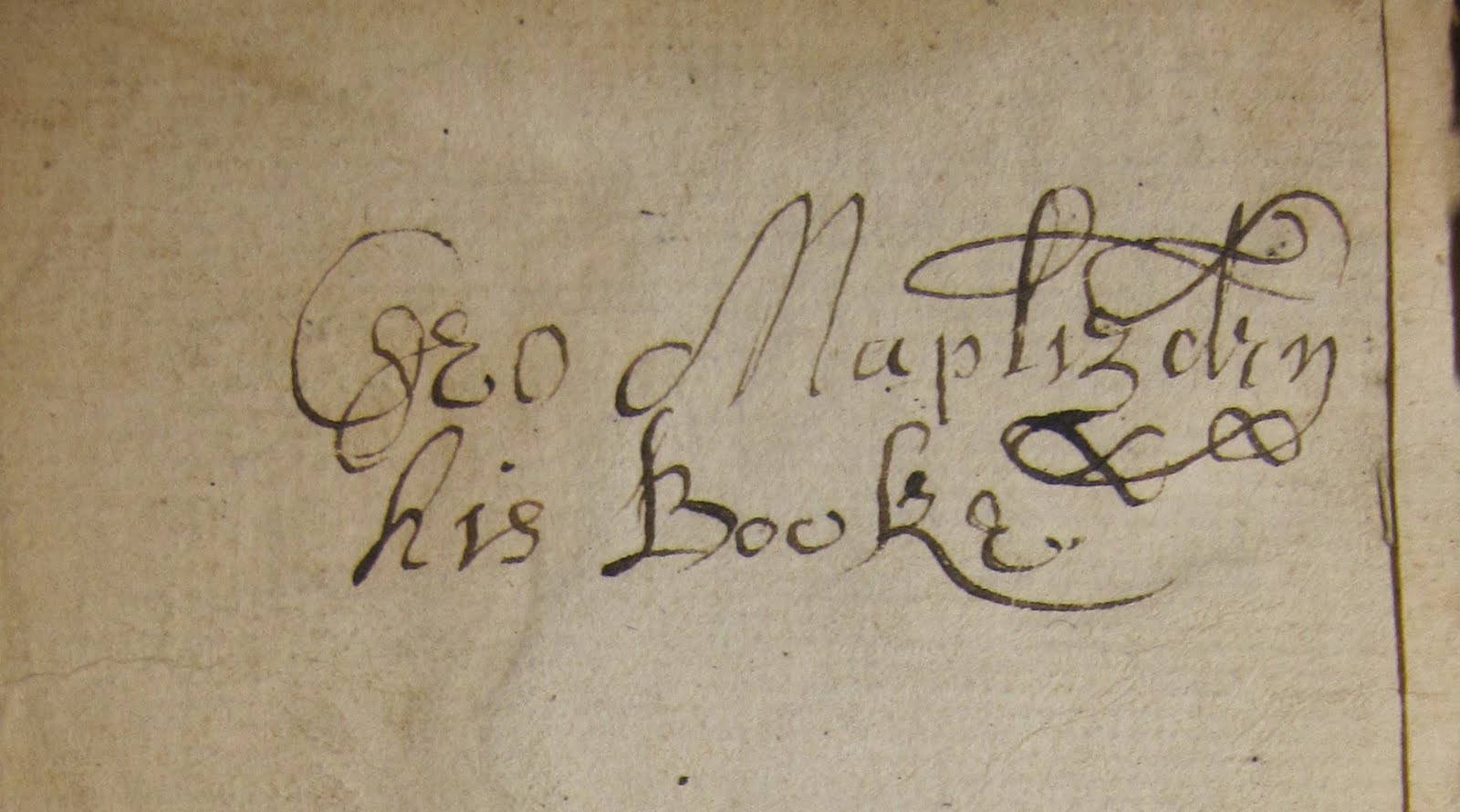
Renaissance Center copy is in contemporary calf, with a single large panel stamp on each cover and author’s name in ms. on fore-edge (rebacked; covers detached); in phase box; signature of Richard Harvey on title page; armorial crest bookplate of George Thomas Wyndham (with motto "Au bon droit") on front pastedown; signature "Geo M[aplizdry?] his booke" on rear free endpaper; pencil note and clipped bookseller’s description laid in. 

A sixteenth-century English "Harvey" also owned this pocket-sized collection of Vida's works, printed in Lyon by the famed Gryphius Press. The Italic inscription "r. harueij" ("R. Harvey's") belongs to Richard Harvey (1560-1630), the astrologer and younger brother of  Gabriel Harvey (1552/3-1631), scholar and friend of Spenser. Harvey inscribed the author's name on the book's fore-edge:


It reads "uid:" i.e. "vid[a]." An early owner (perhaps Harvey) added this note to a detached leaf

 
It reads:

Huius Auctoris Constitutiones Synodales excusa sunt Cremona A.D. 1562. vide Auctarium  Verderii ad Bibliothecam Simleri p. 24

or

The Synodical Decrees of this author were printed [at] Cremona in A.D. 1562. See Auctarium Verderii ad Bibliothecam Simleri [Verderi's addition to Simler's Library] p. 24

Vincenzo Conti printed the quarto Latin book Hieronymi Vidae Albae episc. et comitis Constitutiones synodales eidem ciuitati ac dioecesi praescriptae at Cremona in 1562. A quick search shows three copies in Italy, and one in the United States (Harvard). I have been unable to identify the cited title from the note (lost book?).

A pair of leaves laid in (one probably attached to the book at some time) record bookseller's research into the book, and provide evidence for its sale in the late nineteenth or early twentieth century.


Finally, the book's front pastedown bears the armorial crest bookplate of George Thomas Wyndham (1806-1830) of Cromer Hall, Norfolk.

Look for an update early next week with more images of manuscript material from this book that I haven't had a chance to photograph. 

UPDATE: You will find two new images beIow just added today, both pieces of manuscript content from Vida, Opera. 

John Lancaster (in his catalog notes) reads this inscription "Geo M[aplizdry?]," and I haven't come up with a better transcription. Anyone heard of this guy?

Finally there is this marginal note in Richard Harvey's hand on p. 193 (mentioned in the bookseller's description shown above). It reads "Homobonus Nouembris. 13," and accompanies some interesting pen marks and underlining. He refers to St. Homobonus of Cremona, whose feast day is November 13. I haven't figured out the Cremona connection between this marginal note and the note earlier in the book about the printing of Vida's Constitutiones synodales.
 

Wednesday, May 4, 2011

Exhibit for Center's Garden Conference (5/7)

I've been busy today preparing a small exhibit of rare books for this weekend's Garden Conference at the Renaissance Center. The following images and descriptions are derived from the exhibit.

"You have wisely ordered your vegetable delights, beyond the reach of exception"
--Sir Thomas Browne, The Garden of Cyrus (1658) 
 

the Garden of Eden, from The Holy Bible [Bishop's Bible] (1602)
“And the Lord God placed a garden Eastwarde in Eden, and there he put the man whome he had made. For out of the grounde made the Lord God to growe everie tre pleasant to the sight, and good for meat: the tre of life also in the middes of the garden, and the tre of of knowledge of good and of evil” (Geneva Bible, 1560: Genesis 2:8-9).

Early printed Bibles frequently contain woodcut images of Eden, as seen above in the image from the 1602 Bishop's Bible. Our quarto copy of the KJV features a similar image. 

Engraved illustration in Paradise Lost (London: Tonson, 1705): Book Nine
The engraving shown here illustrates Book Nine of John Milton's Paradise Lost, and depicts  the serpent tempting and suborning Eve to eat the forbidden fruit.
Engraved illustration in Ariosto's Orlando Furioso, trans. John Harington (1591): Canto Six
To complete their intended quests and fulfill the prophecies of ghosts and gods, epic heroes have had to face a seemingly endless series of redoubtable foes, including disaffected gods (Poseidon and Juno), monstrous creatures (Scylla and Polyphemus), and uninvited house guests (Penelope’s suitors). Yet these heroes must also avoid distraction, especially in the form of luxurious, paradisal lands inhabited by beautiful goddesses (Odysseus with Circe on Aeaea and Calypso on Ogygia; Aeneas with Dido at Carthage).  Modern readers might upbraid Odysseus and Aeneas for loving and leaving these women, but in the early modern period these paradisal places became literary tropes, imaginary locations symbolizing the deadly allure of seemingly beautiful lands and people. In the epic tradition of the Italian Renaissance, these places were figured as enchanted gardens, most notably those belonging to Alcina in Ariosto’s Orlando Furioso (1516) and Armida in Tasso’s Gerusalemme Liberata (1580). The first garden is described in Harington's English translation as a place where the “air is alway temperate and cleare, / And wants both winters storms, and summers heate, / As though that Aprill lasted all the yeare.” After luring the knight Ruggiero into her sumptuous palace, Alcina reveals her true form as a witch, a deformed hag made beautiful through enchantment.

Ariosto’s poem had an enormous influence on Edmund Spenser’s Faerie Queene (1590), whose allegorical knight Guyon encounters the “Bower of Bliss” in Book Two. In the last canto Guyon enters the bower, “a place pickt out by choice of best alive, / That natures worke by art can imitate: / In which what ever in this worldly state / Is sweet, and pleasing unto living sense … Was poured forth with plentifull dispence, / And made there to abound with lavish affluence.” Despite its profound beauty, the Bower of Bliss is a site of temptation and evil in the allegorical project of the poem, and so must be destroyed. In an unsettling show of violent power that to this day troubles critics, Guyon brutally razes the bower to the ground, spoiling its “plentifull dispence” and “lavish affluence”:

                      But all those pleasant bowres and Pallace braue,
                      Guyon broke downe, with rigour pittilesse;
                      Ne ought their goodly workmanship might saue
                      Them from the tempest of his wrathfulnesse,
                      But that their blisse he turn'd to balefulnesse:
                      Their groues he feld, their gardins did deface,
                      Their arbers spoyle, their Cabinets suppresse,
                      Their banket houses burne, their buildings race,
                      And of the fairest late, now made the fowlest place.

"May," from John Evelyn, Kalendarium hortense (1683)
One of the Center's several early printed almanacs, John Evelyn’s Kalendarium hortense (1683) is subtitled “The Gard’ners Almanac, directing what he is to do Monthly throughout the year.” In the “Introduction to the Kalendar,” Evelyn notes that “as Paradise… was no longer Paradise than the Man was put into it to dress it, and to keep it; so, nor will our Gardens (as near as we can contrive them to the resemblance of that blessed abode) remain long in their perfection, unless they are also continually cultivated.” For every month of the year Evelyn offers his readers basic information (length of month, average times of sunrise and sunset), a list of tasks “to be done” in the garden (including planting, pruning, fertilizing, etc.), and a list of “flowers [or fruits] in prime, or yet lasting.”

Sir Thomas Browne, The Garden of Cyrus (1658)

a Quincuncial Pattern
Well known for his work as a physician and empirical scientist, Sir Thomas Browne (1605-1682) was one of early modern England’s most inventive prose writers, composing  unique works like Religio medici (1642) and Pseudodoxia epidemica (1646). His Garden of Cyrus, or, The Quincunciall, Lozenge, or Net-work Plantations of the Ancients, Artifically, Naturally, Mystically Considered (1658) is a prolonged commentary and meditation on “X”-shaped forms in the human, natural, and mystical worlds. The “quincunx,” which literally means “five-twelfths” and was used in Classical antiquity to describe the spots of the “five” on a die, is “a pattern used for planting trees in which they are arranged in one or more groups of five, so placed that four occupy the corners of a square or rectangle and the fifth occupies its center” (OED). You can see an example of a quincuncial pattern in the image above. 

Intended as a “Garden Discourse” rather than a “massy Herball” (like John Gerard’s Herball—also owned by the Center), the work begins with a discussion of Babylon’s hanging gardens and the quincuncial layout of King Cyrus’ garden at Sardis. As the author notes in the dedicatory epistle to Nicholas Bacon, The Garden of Cyrus "range[s] into extraneous things, and many parts of Art and Nature...follow[ing] herein the example of old and new Plantations, wherein noble spirits contented not themselves with Trees, but by the attendance of Aviaries, Fish Ponds, and all variety of Animals, they made their gardens the Epitome of the earth, and some resemblance of the secular shows of old." 

Browne proceeds to trace the “X” or “net-work” (i.e. shaped like a net) pattern in the world around him, noting architectural styles, manners of sitting cross-legged, reticulated windows, the “pyramidal” cuts on precious gems, staggered battle lines, and astral constellations. His account of terrestrial and submarine plant life finds the quincunx in pineapples, seed pods, leaf structures, and various flowers. He finds it in the animal world, marking the scales of rattlesnakes and fish, the bee’s honeycomb, and even human skin. He points out that the motion of fins, wings, and human limbs depend on a back-and-forth, X-shaped movement. He even likens the elliptical shape of sound and light waves to the “decussated” line of the quincunx. At the end of his treatise, Browne applies the quincuncial  form to  more abstract ideas, including “intellectual reception” (“intellectual … lines be not thus rightly disposed, but magnified, diminished, distorted, and ill placed … whereby they [people] have irregular apprehensions of things”) and mystical philosophy. The structure of a garden, as Browne so creatively implies, can indeed reflect the organizational principles of nature itself, and become an “Epitome  of the world.”

Friday, April 22, 2011

"A Little Dictionary of Eight Languages"

Today's post highlights one of my favorite early printed books in the Center's collection, an eight-language pocket "dictionary" which presents itself as a series of formal dialogues. While books without unique manuscript content or provenance are typically not the subject of this blog, this "little Dictionary of eight languages" is simply too wonderful to ignore.  


New Dialogues or colloquies, and, a little Dictionary of eight Languages [...]
London: Printed by E[dward]. G[riffin]. for Michael Sparke, junior [...], 1639.
STC 1432
contemporary calf binding, rebacked

This printed language aid is based on the work of Noël de Berlemont (d. 1531), who wrote a dictionary and series of Flemish-French colloquies in the sixteenth century (see catalog record). As its title page suggests this is "a booke very necessary for all those that Studie these tongues, either at home or abroad," in addition to "Travellers, young Merchants and Sea-Men, especially those that desire to attaine to the use of these Tongues." The "tongues" in question are eight in number: Latin, French, Low and High Dutch, Spanish, Italian, English, and Portuguese. The absence of Greek and Hebrew emphasize the practical (rather than scholarly) purpose of the book.

Many writers of educational treatises in the early modern period adopted the colloquy, or formal conversation, as a structuring component of their works; in fact, the Center also owns a book of Sea-Dialogues, a set of conversations between a captain and crew member that explicate numerous points of seamanship and navigation. While to the modern reader a formal, prescribed dialogue may come off as a bit of an odd method for language instruction, books like this were actually fairly common in the period and have made a lasting impact on phrasebooks ever since. The main difference between the two lies in the fact that modern phrasebooks feature only snippets of conversation rather than entire discussions and debates; the larger conversational context is left open to the vagaries of lived experience in the world. 

 New Dialogues or Colloquies, on the other hand, presents detailed conversations held among groups of hypothetical diners, travelers, merchants, etc. on subjects such as eating, shopping, asking directions, and settling debts. In the first preface "to the reader" (first image above) the author promises his dialogues have been "pleasantly, morally, and politely...penned," that he has "taken as much paines in this Schoole of Conferences or Colloquiums, as any man living," and has therefore had them "handsomely printed." (Unfortunately heavy foxing has made our copy far from "handsome.") 

The second preface to the reader (translated into eight different languages, as seen in the second image above) claims that "this Booke is so needfull and profitable, and the use of the same so necessary that its goodnesse, even of learned men, is not fully to be praised." 


The best (well, most entertaining) dialogue is entitled "A Dinner of ten persons, to wit, Hermes, John, David, Mary, Peter, Francis, Roger, Anne, Henry, and Luke." (And I have no idea why Hermes is the only hypothetical diner named after a Greek god—is he the foreigner here?) While many of the dialogue's translated phrases are commonplace enough for practical travel use, the unlikelihood of a conversation following this particular form makes the whole colloquy quite comical.

"J: Eate it not all, let that alone which ye shall have too much. 
P: Wherefore eate you not your pottage while it is hot. 
F: It is yet too hot.
M: [with a total non sequitur] John, bring here bread, Roger hath no bread, goe fetch a trencher, and bring here mustard. 
P: Give me the beere-pot.
R: Hold there, hold it well. 
P: Let it goe, I hold it well. 
M: Peter, drink not after thy pottage, for it is unwholesome: eate first a little before you drinke. Peter, cut me fleshe."

This colloquy is fairly representative of the entire book. One sees the practical use of certain phrases here and there, as did an early underliner, who has noted "while it is hot," "mustard," "beere-pot," and "after thy pottage" (in Spanish and Low Dutch). But in terms of a conversation this exchange is chaotic at best. What happened to the bread and mustard? Has Francis' pottage cooled yet? When will they give Peter a break so he can drink his beer? Clearly the formality of the colloquy as a genre doesn't preclude the conversation from devolving into a loosely connected series of phrases from time to time.

Here is more of the dinner conversation:


I particularly like (in the third  and fourth images) the exchange about the knife and eating habits:

"A: Roger, lend me your knife, I pray you.
R: Take it, but give it me againe when you have eaten.
A: If I give it not you againe, lend it me no more.
R: No indeed.
A: It is a good knife, how much hath it cost you?
R: It hath cost me six pence.
A: It is good cheape: let me have it for that same price, I will give you your money againe.
R: I am content.
[And then Mary, out of nowhere]
M: Roger, you eat nothing [maybe because he lent out his knife?], me thinke that you are ashamed, helpe your selfe, are you ashamed?
R: Doe I not eate well? I eate more than any man that is at the table.
M: That you doe not.
A: You eate nothing yourselfe.
M: I have well eaten. 
P: [in a diplomatic gesture] Let us drincke well, if that we have ill to eate."
 

Tuesday, April 19, 2011

Bookplates and Provenance III

Today's post highlights a few more bookplates from the Center's rare book collection. As in similar entries about provenance, I have attempted to track down the people associated with these bookplates and provide you with a bit of information about their lives.

Sir John Vanbrugh, Plays, 2 vols. [Center owns v. 1 only]
London : Printed for J. Tonson, and J. Watts; and for J. Darby, A. Bettesworth, and F. Clay; in trust for Richard, James, and Bethel Wellington, MDCCXXX [1730]. 
Contemporary calf, 12mo
  
Here we have an early twentieth-century plate depicting a pastoral scene. The bookplate was designed by Edwin Davis French (1851-1906), one of the most important bookplate designers of the nineteenth century. This plate is signed 1906 (I think, it may read "1900"), and considering its late date it is likely this is one of the last plates French designed. 

"Nathan T. Porter, Jr." is most likely Nathan Todd Porter, Jr., a New York businessman born in Brooklyn on December 5, 1867. He attended high school in Montclair, NJ, and graduated from Yale in the class of 1890. According to the 1907 edition of Who's who in New York City and State, Porter was a "dry goods commission merchant," and ran the firm Porter Brothers and Company with his brother Thomas Wyman Porter. 
 
The Elizabeth Club at Yale University owns several early printed playbooks with Porter's bookplates. See Stephen Parks, The Elizabethan Club at Yale University and its Library (New Haven: Yale University, 1986), 51, 74, 82, 108, 117, 120.


Boethius, De consolatione philosophiae.
Lugduni Batavorum [Leiden]: Ex officina Hackiana, Ao. M D C LXXI [1671].
Contemporary full vellum binding.

This bookplate and inscription belong to Augustus Montague Summers 
(1880-1948),an eccentric Englishman who wrote on subjects as various 
as the occult and Restoration drama. The signature dates from his youth:
in 1899 he entered Trinity College, Oxford, where he received two degrees
(B.A.1905; M.A.1906). The bookplate (signed by an unidentified "J.W.") 
probably dates to this early part of Summers' life as well, since we know
of a later bookplate reading "Alphoinvs Montagve Svmmers Liber svvs" 
(designed by Eric Gill)—Alphonsus being a name in religion Summers' used
after 1910 when he received a clerical tonsure from the Church of Rome
(Davies, ODNB). 

In fact, the ODNB article on Summers' is quite an interesting read. His
career in the Anglican Church was cut short around 1908, when 
"rumours of studies in Satanism and a charge of pederasty" became 
associated with his name. He wrote a number of books on vampires, 
demons, and werewolves. His activities as a literary critic are well
known (he published a history of the gothic novel in 1938), and his
work on English Restoration drama is particularly important 
(including a six-volume Works of Aphra Behn).

Pierre de la Primaudaye, Academie Francoise


A Paris : Chez la vefue Claude de Monstr’oeil, ruë S. Iean de Latran, & en sa 
boutique en la Court du Palais au Nom de Iesvs, M. DC. X [1610]. 
Contemporary limp vellum binding

The Latin quote on this bookplate is from Lucretius, De rerum natura,
Book I, ll. 927-8. In the Rolfe Humphries translation of 1968, the lines
read: "I come to fountains / Completely undefiled, I drink their waters, /
Delight myself by gathering new flowers." The lines metaphorically link
flowers, clear fountains (of the muses), and, of course, books.

Katherine Theresa Butler (1883-1950) wrote a two-volume History of 
French Literature (London: Methuen, 1923), and at the time of its 
publication was Director of Studies in Modern and Medieval Languages
at Girton College, Cambridge.