Among the many books the late Professor William A. Ringler (1912-1987) donated to the Center are five early printed editions of Sir Philip Sidney's Arcadia, all published between 1598 and 1674. Ringler received two of these books from one of his mentors, Professor Robert Kilburn Root (1877-1950) of Princeton University. Today's post highlights the most prized "Ringler Sidney" in our collection, a 1605 edition of The Countess of Pembroke's Arcadia. The book's Ringler and Root provenance certainly make it special, but its high density of seventeenth-century Scottish ownership inscriptions and manuscript notes make it extraordinary: the volume once belonged to the noble Carr/Ker family of Ferniehirst Castle, and may have passed through the hands of Robert Carr, 1st Earl of Somerset (and King James I's disgraced favorite).
By researching and transcribing this volume's unique manuscript content, this post examines the "anthropology of the book" (to borrow Jason Scott-Warren's term), and draws on material evidence to illuminate the literary reading and writing practices of an early modern noble family. (Jason Scott-Warren, "Reading Graffiti in the Early Modern Book," Huntington Library Quarterly 73.3 (2010), 380.)
By researching and transcribing this volume's unique manuscript content, this post examines the "anthropology of the book" (to borrow Jason Scott-Warren's term), and draws on material evidence to illuminate the literary reading and writing practices of an early modern noble family. (Jason Scott-Warren, "Reading Graffiti in the Early Modern Book," Huntington Library Quarterly 73.3 (2010), 380.)

The front flyleaf offers the first few pieces of evidence we can use to trace the book's provenance.

“This book of Arcadia was given me by my Dearest Ant ^dam Ann Ker^ [i.e. Dame Anne Ker] Lady Balmerino in Anno 1647 Jedbrugh" [“Jedbrugh” being a variant spelling for the Scottish town of Jedburgh]
The story of this book's ownership begins in medias res, forty-two years after it was printed in London. Ann Ker/Carr (Scottish/English) was the wife of John Elphinstone, 2nd Lord Balmerino (whose ownership inscriptions fill the margins later on in the book), the daughter of Sir Thomas Carre of Ferniehirst Castle, and the brother of Robert Carr, 1st Earl of Somerset (1585/6?-1645). The inscription's implied nephew is probably Robert Carr, 3rd Lord Jedburgh, who died in 1692 without issue. When Lady Ann (d. 1650) presented this book to Robert in 1647, its pages were already deeply marked with the signs of former owners and reading practices, having been circulating among noble Scottish readers associated with the Kers/Carrs of Ferniehirst Castle and John Elphinstone, 2nd Lord Balmerino.
But before moving to the volume's interior manuscript content, we must consider the remaining evidence supplied by the front flyleaf, which further illuminates the book's life in the eighteenth and twentieth centuries.
The story of this book's ownership begins in medias res, forty-two years after it was printed in London. Ann Ker/Carr (Scottish/English) was the wife of John Elphinstone, 2nd Lord Balmerino (whose ownership inscriptions fill the margins later on in the book), the daughter of Sir Thomas Carre of Ferniehirst Castle, and the brother of Robert Carr, 1st Earl of Somerset (1585/6?-1645). The inscription's implied nephew is probably Robert Carr, 3rd Lord Jedburgh, who died in 1692 without issue. When Lady Ann (d. 1650) presented this book to Robert in 1647, its pages were already deeply marked with the signs of former owners and reading practices, having been circulating among noble Scottish readers associated with the Kers/Carrs of Ferniehirst Castle and John Elphinstone, 2nd Lord Balmerino.
But before moving to the volume's interior manuscript content, we must consider the remaining evidence supplied by the front flyleaf, which further illuminates the book's life in the eighteenth and twentieth centuries.

The Jacobean-style armorial bookplate of "Mr George Carre Advocate" fills the middle of the page, bearing Carre's personal Latin motto "fortunam sapientes ferunt." (Translating to "the wise endure fortune," the motto derives from "stulti timent Fortunam, sapientes ferunt," or "the foolish fear fortune, the wise endure her.") The motto "tout droit" ("to the front" or "straight ahead") frames the lawyer's arms from above. Magnae Britanniae Notitiae of 1748 lists a "George Carre, advocate," while the twenty-eighth volume of the Scots Magazine records a "George Carre of Nisbet, Esq, one of the Lords of Sessions," dying on February 21, 1766.

The flyleaf's final provenance notes chronicle the book's ownership trajectory in the twentieth century: "After a century and a half it was given to William Ringler by R.K. Root" and "This is the 1605 edition (STC 22543-43a). WR." It is likely the first note is a gift inscription written by R.K. Root, and the second a bibliographical note by William Ringler (although also possible that both are in Ringler's hand). Root's death in 1950 provides the terminus ad quem for dating the book's transfer of ownership. The "century and a half" of the first note may correspond to ca. 1790-1940, perhaps the period of time the book remained in Root's family after they acquired it from the Carrs in the late eighteenth century. There is simply not enough evidence here to establish such dates for certain, however, so this part of the book's biography must necessarily remain incomplete.
Three approximate points in time (1647, mid eighteenth century, mid twentieth century) punctuate major periods in the book's provenance history, adumbrating its movement from the Scottish nobility to an eighteenth-century lawyer, and finally to a pair of modern literary scholars. Looking beyond the flyleaf into the margins of the Arcadia itself, however, the inscriptions and "graffiti" of former owners supply a rich portrait of the book's seventeenth-century life, which in this case is more thoroughly documented than its later provenance in the nineteenth and twentieth centuries.

As one can see from this typical page in Book One, the volume has seen heavy use over time (note the water stain and generally worn appearance); a former owner also rotated the book to write a horizontally oriented manuscript note in the right-hand margin.

"Harry stewart wth my hand at Edenburgh 12 day feb: 1644”
This is one of the volume's many untraceable ownership inscriptions, being written by an unremarkable person with a commonplace name. But the note succeeds in locating the book in a very specific time and place three years before Ann Kerr gave it to her nephew, and suggests it moved back and forth between Edinburgh (site of her husband's political career) and the Scottish border towns around Jedburgh over the course of the seventeenth century.

A few pages later a "Kristian Thomsene" signed his name in a secretary hand that looks much older in style than "Harry Stewart's" above. The note seems to read "Kristian Thomsene printed her[e]," "printed" being OED "print" trans. 4: "to commit something to writing; to express in written words; to write down." (The OED has the sense falling out of usage after 1612, which would corroborate the early date suggested by the handwriting.)

Later in the volume (Book Three), this same "Kristian Thomesane" signed his name again. Another frequently repeated signature belongs to a "Walter Lorrane."

"Walter Lorane"

"Walter Lorrane"

"Walter Lorane"
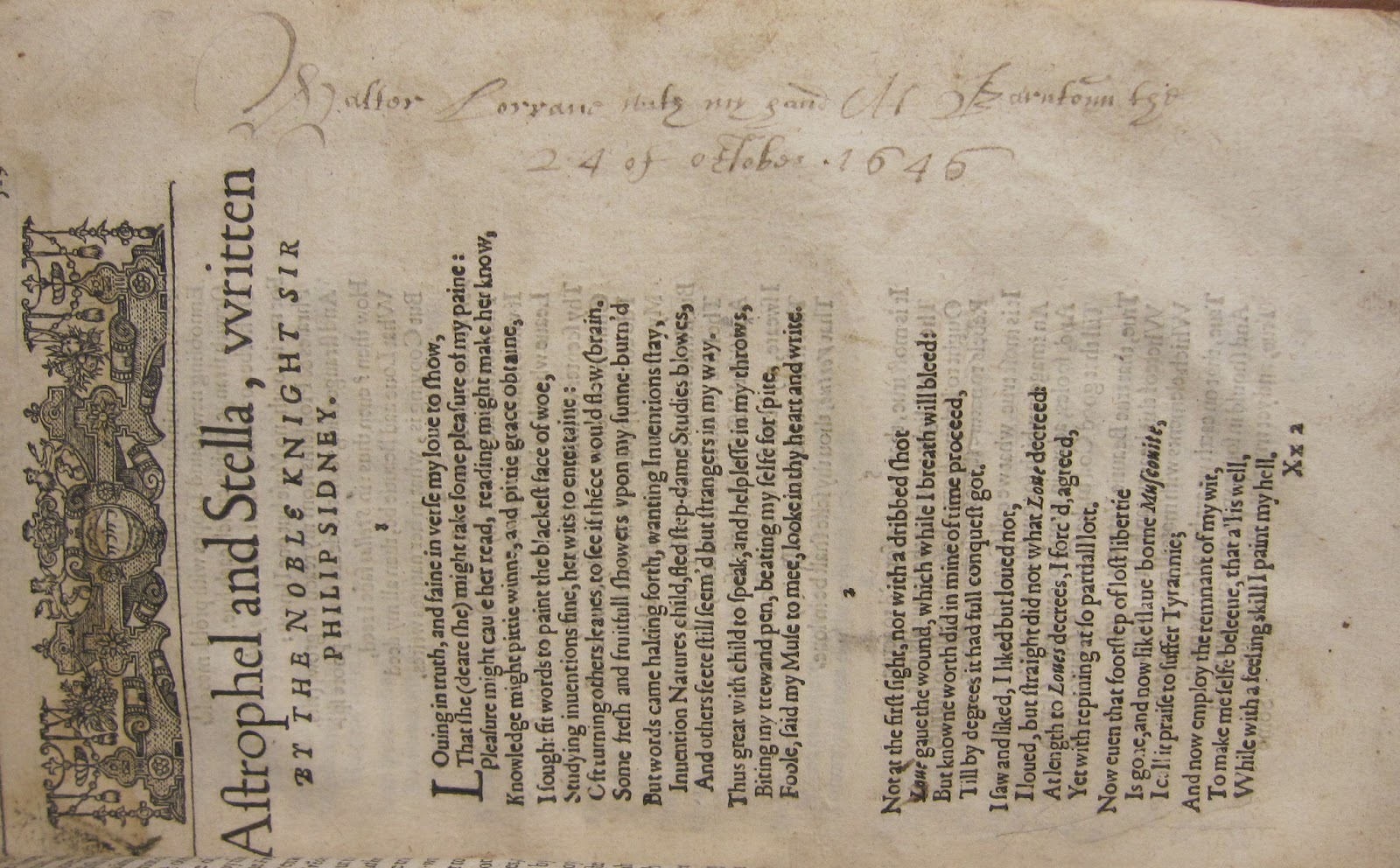
"Walter Lorrane with my hand At Barntoun the 24 of October 1646"
The last of these inscriptions, like the Harry Stewart signature of 1644, dates to the last few years of Lady Ann Ker's ownership, and again locates the book in a specific time and place. ("Barntoun" or Barnton lies a few miles outside of the capital, being the Edinburgh home of John Elphinstone, 2nd Lord Balmerino.) Ten years earlier a "William Goldmane" dated his signature 1634; he (and his kin) signed the book several times.

"Williame Goldmane 1634"

"Per me Guilielmum Goldmane"

"James goldmane Margret ogilis [or ogilvie] Williame goldmane"
Similar to "Kristian Thomesane" above, most former readers/owners of the volume did not date their inscriptions, although paleographical evidence dates all of them to the seventeenth century.
The name "John Glandinine/Glendonying" also appears at several points in the book.
The name "John Glandinine/Glendonying" also appears at several points in the book.

"John Glendonying"

"Jhone o glandinine Jhone o glandinine"
As does "John Douglas."

"Johne douglas wth my hand"
One inscription offers a brief glimpse of a reading experience: "Alexander Wodde" signed his name at the end of Book One to signal his completion of the Arcadia's first section, writing "finish amen be me alexander wodde." At some point a subsequent owner/inscriber added otiose descenders to the name "alexander wodde," rendering the name partially illegible. We have no way of knowing what Wodde thought about his reading.

As I mentioned above, the provenance information presented on the volume's front flyleaf accompanies a series of additional inscriptions related to the Scottish nobility (the Carrs/Kers and John Elphinstone, 2nd Lord Balmerino).

"J. Elphinston J. Elphinston"

"J. Elphinston Mr of Balmerino"

"J. Elphinstone"
Elphinstone (d. 1649)—husband of the Ann Ker mentioned on the flyleaf inscription—left behind several ownership inscriptions, and it is likely he added his name after marrying Ann Ker in 1613. (I will write more about this below, but it seems the book passed primarily through the Carr/Ker family, only picking up the Elphinstone associations through marriage.) Balmerino had an early run-in with Charles I in 1634, when he was sentenced to death by the King's council for possessing "a petition critical of royal ecclesiastical policy" (ODNB entry by John Coffey). Charles would remit the punishment in 1635, allowing Elphinstone to return to his estate at Balmerino (Fife, Scotland) and launch an eventful political career lasting until his death in 1649. But the book's history goes back even further than the Kerr-Elphinstone marriage in 1613. Several "Carr/Ker/Qere" inscriptions, all written in secretary hands appropriate for ca. 1605-1612, point to the volume's earlier circulation among the Kerrs of Ferniehirst castle. There are several "Robert Carr" signatures, and these could refer to either Ann's brother (later 1st Earl of Somerset) or her nephew (3rd Lord Jedburgh); in other words, they could date to the book's life either before or after the Balmerino marriage. In all likelihood, the signatures of both men are represented here.

"Robert Carr"

"Robert Carr" [different hand]

"Robert Qere"
The strongest impression of the italic "Robert Carr" signature (matching the second example shown above) can be found in the next image, which also bears the inscriptions of Walter Lorrane and Thomas Carre (and a secretary-hand "Robert Carre").

It seems two hands are responsible for the book's "Robert Carr" inscriptions, but without comparing these specimens to known examples of hands from potential candidates, it is difficult to tell for certain if this is true.
"Jeane Ker" (unidentified) signed the book in italic with a creatively embellished majuscule "J" and K."

"be me Jeane Ker with my [hand]"
Robert Carr/Qere (x2), Thomas Carr, Jean Ker, Ann Ker, John Elphinstone, William Goldmane, James Goldmane, Margret Ogilvie, Christian Thompson, Walter Lorrane, John Glendonyne, Harry Stewart, John Douglas, Alexander Wodde. From this tangle of names and dates we can pinpoint specific moments of the book's life, although significant temporal gaps remain.
Dated inscriptions:
1634 William Goldmane [probably same time as James Goldmane and Margret Ogilvie]
1644 (Feb. 12) Harry Stewart [at Edinburgh]
1646 (Oct. 24) Walter Lorrane [at Barnton]
1647 "Jedburgh" [prob. Robert Carr, 3rd Lord Jedburgh]
1646 (Oct. 24) Walter Lorrane [at Barnton]
1647 "Jedburgh" [prob. Robert Carr, 3rd Lord Jedburgh]
Other ownership dates:
[1650 Death of Ann Ker]
[mid-eighteenth century] George Carre, Advocate
[ca. 1790-1940? book in Root family?]
ca.1940s? R.K. Root gives two early printed Arcadias to Ringler
But this information by no means creates a full or complete picture of the social practices defining this book's ownership history. Other marks in the volume, including a full set of indexical secretary-hand notes in the margins of Book Three, embody material interactions between readers and text through writing. Heidi Brayman Hackel's chapter on "Noting readers of the Arcadia in marginalia and commonplace books" is the standard study of Sidney's prose romance as "reading material," and her conclusions about the types of annotations found in surviving copies (pp. 138, 156-169) inform my own assessment of the Center's heavily inscribed "Ringler Sidney."
[Heidi Brayman Hackel, Reading Material in Early Modern England (Cambridge: Cambridge University Press, 2005)]
Unfortunately for our efforts to transcribe such annotations, many of the notes on recto pages were slightly trimmed during an eighteenth- or nineteenth-century rebinding.
[mid-eighteenth century] George Carre, Advocate
[ca. 1790-1940? book in Root family?]
ca.1940s? R.K. Root gives two early printed Arcadias to Ringler
But this information by no means creates a full or complete picture of the social practices defining this book's ownership history. Other marks in the volume, including a full set of indexical secretary-hand notes in the margins of Book Three, embody material interactions between readers and text through writing. Heidi Brayman Hackel's chapter on "Noting readers of the Arcadia in marginalia and commonplace books" is the standard study of Sidney's prose romance as "reading material," and her conclusions about the types of annotations found in surviving copies (pp. 138, 156-169) inform my own assessment of the Center's heavily inscribed "Ringler Sidney."
[Heidi Brayman Hackel, Reading Material in Early Modern England (Cambridge: Cambridge University Press, 2005)]
Unfortunately for our efforts to transcribe such annotations, many of the notes on recto pages were slightly trimmed during an eighteenth- or nineteenth-century rebinding.

"Philo. her *** to cecrop[??]" AND "a relation o[f] Cecro: of a[**] false prat[***] against B[***] and of ye lades [***] to her son"

"Cecropia wooing for her sone Amph:"
These two examples (representing only a very small fraction of the Book 3 MS notes) are typical in the way they indexically summarize the prose romance's labyrinthine plot. The notes do little to express the personal opinion or taste of the reader, but rather function as reference tools for private use or as guides to new readers. I have not been able to match the hand of these notes to any of the early ownership inscriptions described above.
To conclude the post, I present the volume's "miscellaneous" manuscript content, comprised of transcriptions from prayers, poems, and the printed Arcadia itself.

"MOMO"—a child's hand?

"The countess of pembroke's Arcadia Written be Sr philip sidney" [in a stylish secretary hand, the style especially evident in the majuscule "W"]

"Since that ye storme of pas Robert" [transcribing/altering the beginning of the printed italic verses]

"ye lord is only my support and"

"Let him drinke this whom longe in armes to fold
thow doest desuere [desire] and wth free power to hold"
[these lines are transcribed from the facing page (p. 365)

"in the o lord doe I put my trust let me never be confounded nor put
to shame that puts there the trust in ye" [Psalms 31:1]
These transcribed fragments of prayers and poems may not present a complete view of the reading practices historically associated with the book. But their presence nonetheless adds to the total picture of its early modern provenance, and helps us flesh out its life from the jumble of names and dates inscribed within. Since we can confidently link some of these names to figures for whom biographical information exists, it is possible to contextualize inscriptions, reading notes, and marks in books against other types of historical documentation, including additional printed books owned by these readers, their manuscript writings, and their personal correspondence. Piece by piece, a fuller picture of reading history could emerge from collaborative, trans-institutional work on such inscriptions.


