Showing posts with label reactionary annotation. Show all posts

Friday, February 25, 2011

William Ringler Annotates Sidney


[Various editions of Sir Philip Sidney's poetry and prose, annotated by William A. Ringler Jr., editor of the landmark Poems of Sir Philip Sidney (Oxford: Clarendon Press, 1962), including:

The Complete Poems of Sir Philip Sidney, ed. Alexander B. Grosart (London, 1877)

Astrophel and Stella, ed. A.W. Pollard (London, 1888)

The Last Part of the Countesse of Pembrokes Arcadia, Astrophel & Stella and other Poems, The Lady of May, ed. Albert Feuillerat (Cambridge, 1922)

Astrophel and Stella, ed. Mona Wilson (London, 1931)
  
Astrophel et Stella, ed. Michel Poirier (Paris, 1957)

Not all of our rare books are all that old. Our interesting collection of books annotated by twentieth-century Renaissance scholars—including those donated by Samuel Schoenbaum and the historian J.H. Hexter—are absolutely unique, one-of-a-kind items, many of which reveal the genesis of important scholarly work; for example (and I will probably blog about this one day), we own Samuel Schoenbaum's copiously annotated copy of Alfred Harbage's Annals of English Drama, a book updated by Schoenbaum in a revised edition of 1966.

In today's entry I discuss our most important collection of books annotated by a famous scholar, the editions of Sir Philip Sidney's poetry formerly owned by William A. Ringler, Jr. These books are important not only because the extensive annotations help us understand how Ringler thought and worked, but also because he used these books to prepare and establish the texts of Sidney's poetry for his 1962 edition. For the rest of this entry I will investigate the case of Sidney's famous sonnet sequence Astrophel and Stella, with an eye towards understanding how Ringler used book-annotation to prepare his edition.

According to his textual notes on Astrophel and Stella in the Clarendon Poems (457), Ringler checked six different modern editions in the process of preparing his new text: Grosart (1873), Pollard (1888), Flügel (1889), Feuillerat (1922), Wilson (1930) and Poirier (1957). We own Ringler's annotated copies of all these books save the Flügel. The books contain a range of manuscript annotations, almost all of which are directly related to the textual history of Astrophel and Stella. For some of these Ringler used a system of color-coded annotations (referenced in the image above) to record variant readings in different textual witnesses. The abbreviations seen in these books ("13" "98") are the same he uses in the Poems.

Title Page to Grosart's edition (1877)
Grosart based his text on the 1613 quarto, even though he claims he used the more accurate 1598 in his introduction (Ringler 457). At the bottom of this page, Ringler notes "spelling indicates G really makes 1613 his copy text." The rubricated "red='98" at the top of the page, along with the rubricated corrections, demonstrate Ringler adding variants from the 1598 folio edition of Arcadia, which he describes as "the obvious choice for a copy text" (456). This is one of the more lightly annotated of Ringler's books.

Upper cover, Pollard's edition (1888)
Title Page, Pollard's edition (1888)
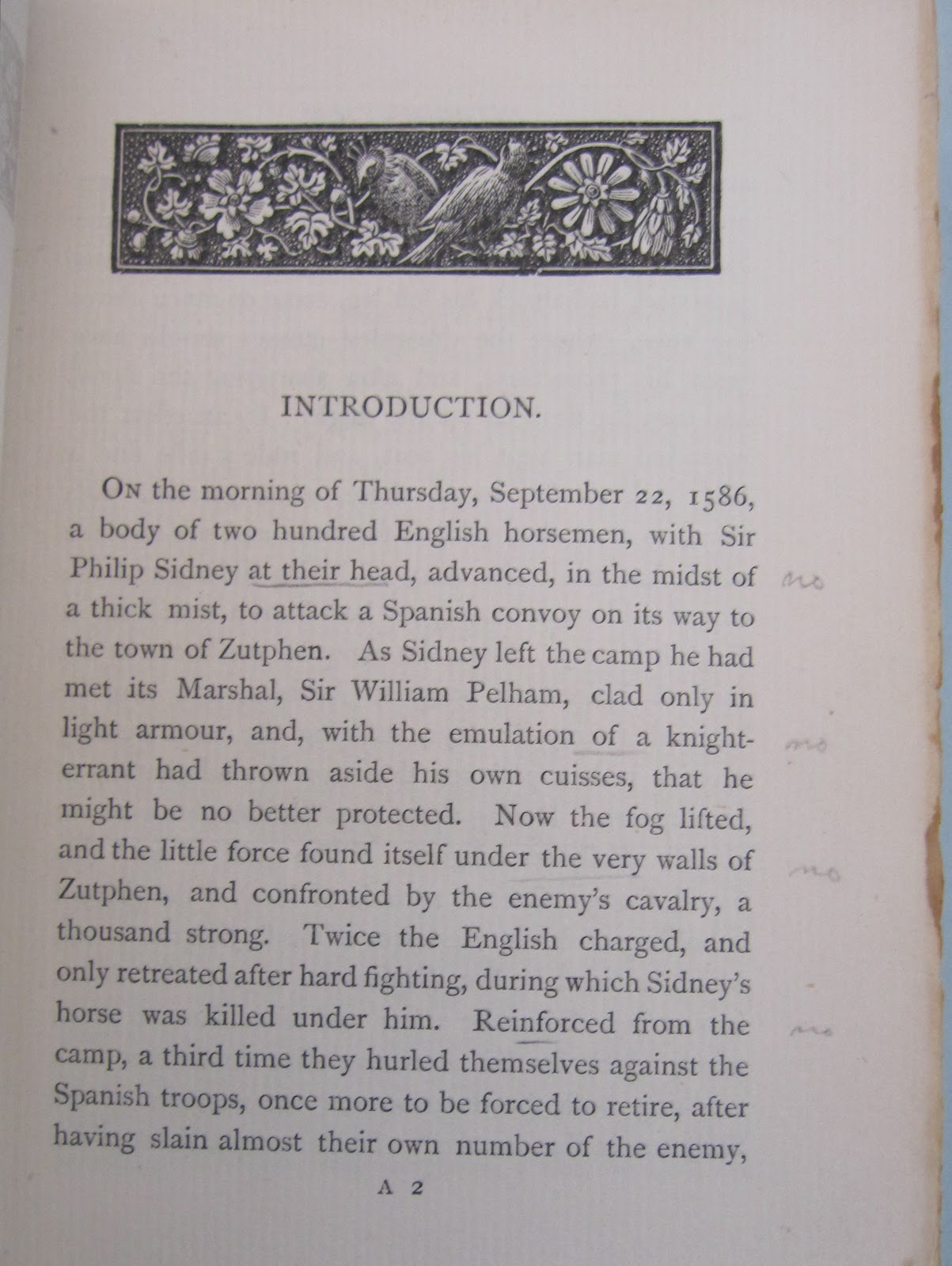
A.W. Pollard, on the other hand, produced "the most conservative and also the best of all the earlier editions" (Ringler 457), partially evinced by the copy's minimal amount of manuscript annotation. To aspects of Pollard's introduction, however, Ringler took exception, especially on several points of Sidney's biography. The four "no"s penciled in the margins (see image above) react to various inaccuracies related the Battle of Zutphen (1586), the event at which Sidney was mortally wounded.
Title page, Feuillerat's edition (1922)
MS notes from Ringler's copy of Feuillerat

If Pollard prepared the best text of the "earlier editions," Albert Feuillerat may have produced the worst. Apparently Feuillerat followed his immediate predecessor (Flügel 1889) in making very poor editorial decisions. Ringler summarizes the situation: "Flügel provided an unhappily inaccurate reprint of Q1, which he wrongly assumed represented the earliest state of Sidney's text...In 1922 Feuillerat, unfortunately following Flügel's mistaken notion of the textual relationships, printed a diplomatic transcript of Q1 with appended variant readings from Bt, Q2, 98, and all subsequent folios, but he provided no analysis of the significance of his variants" (457).

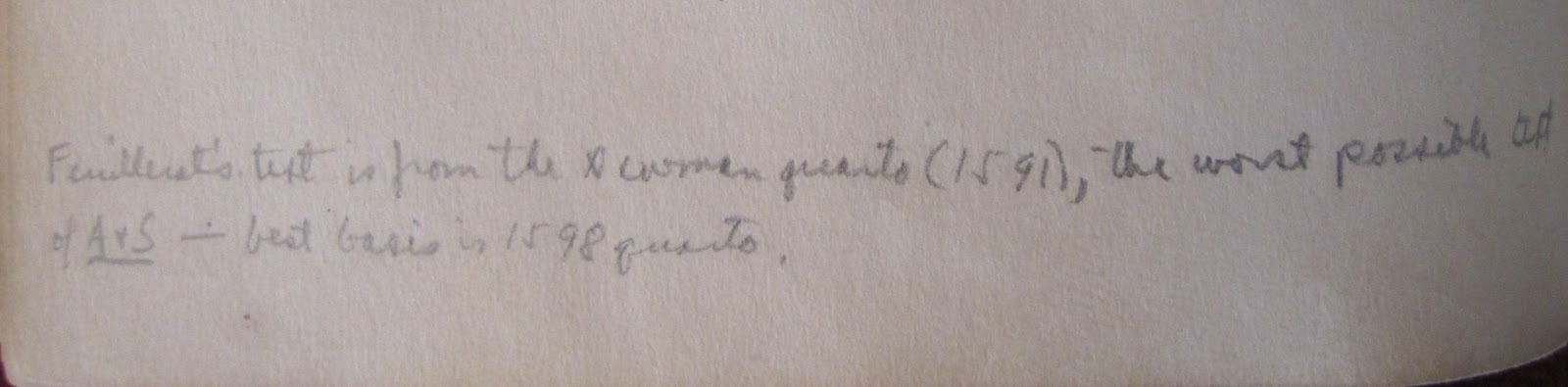
As one can see from the images, Ringler's copy of Feuillerat is the most copiously annotated book from his collection of Astrophel and Stella editions. According to the manuscript note above (last image; taken from page facing the beginning of Astrophel and Stella), "Feuillerat's text is from the Newman quarto (1591) [Q1], the worst possible text of A+S—best basis is 1598 quarto" (I think he means the 1598 folio here, but he could refer to Q3 of A & S, printed [1597-1600]). It is interesting to compare the content and tenor of this MS note to the section quoted above from the 1962 Poems (both of which serve similar evaluative functions); words like "unhappily" and "unfortunately" come off slightly less harsh than the MS "worst possible text."

According to Ringler's color-coded key, the annotations record corrections from Q1 (Feuillerat's copy-text), and variants from Q2, Q3, and "Bt," or, the "Bright Manuscript" (British Library MS Add. 15232). Ringler clearly used his copy of Feuillerat's edition to death, considering the poor state of the binding (see below). 

Mona Wilson's 1930 edition is "based on 98, with 53 emendations from Q1 and Q2" (Ringler 457). Although she wrote a "useful" introduction, Ringler doesn't approve of her "eclectic" method, "her text [being] less close to Sidney's original than Pollard's" (ibid).
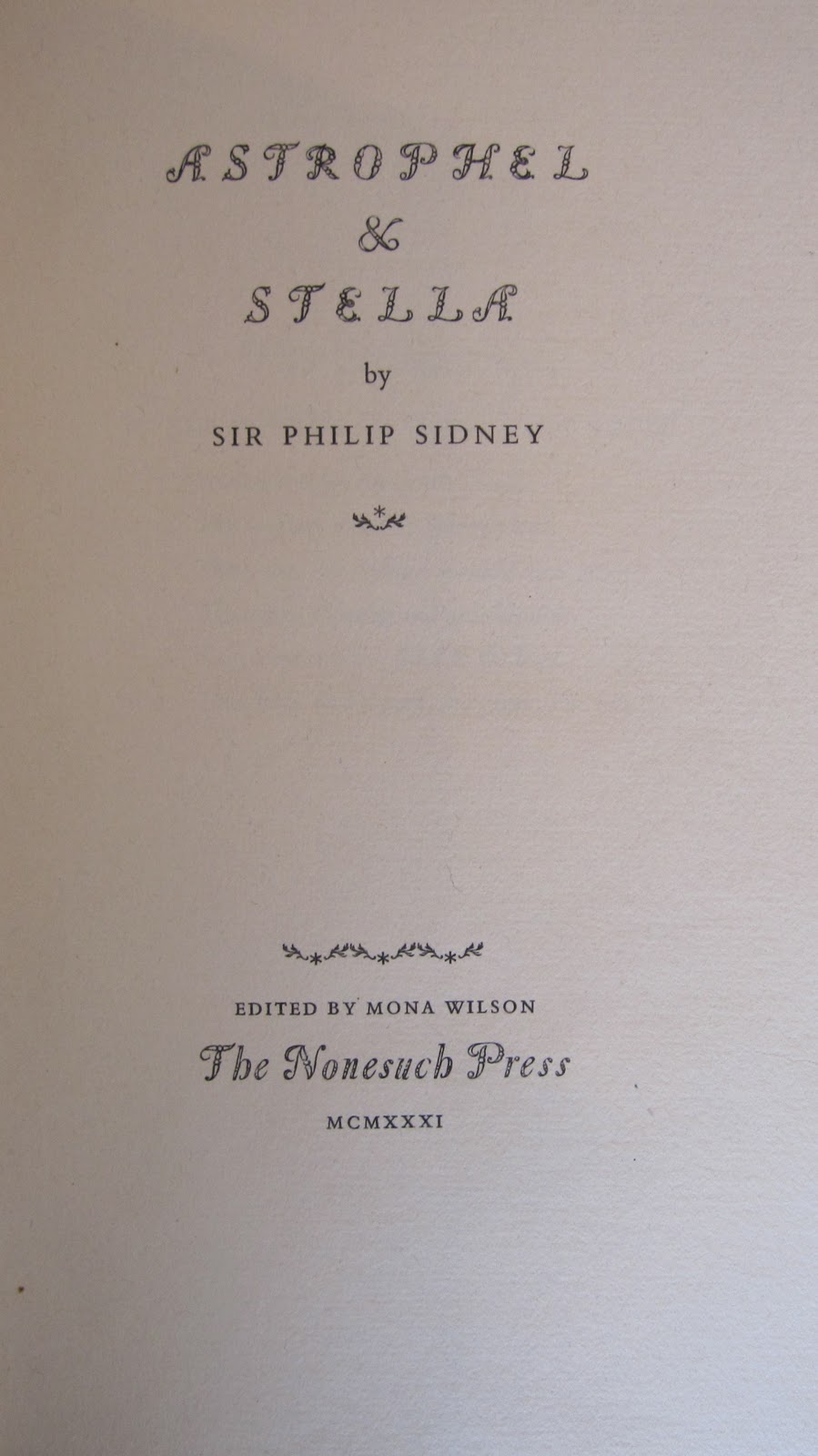

This time without using his typical color-coded system, Ringler notes a number of textual variants in his manuscript marginalia.

Finally, our least annotated but perhaps most personal of Ringler's Astrophel and Stella copies is the French edition prepared in 1957 by Michel Poirier, whose gift inscription to Ringler appears on the half-title.

"To Professor William A. Ringler, with all my best wishes for the completion of his own edition of Sidney's poems. Michel Poirier. December 1957"—a pleasant sentiment, from one Sidney editor to another.

The intellectual labor Ringler invested into these manuscript notes translated directly into his most enduring scholarly work,  the monumental Poems of Sir Philip Sidney. This edition offers an admirable model for any serious editor, and to this day—nearly fifty years after its publication—it remains the standard text of Sidney's poems.


Friday, October 22, 2010

Reactionary Manuscript Annotation

marginal note, p.1

Walter Travers, A full and plaine declaration of ecclesiasticall discipline owt off the word off God, and off the declininge off the churche off England from the same. [Heidelberg]: Imprinted [by Michael Schirat], M.D.LXXIIII. [1574]. STC 24184. 4to. Later half-calf binding with marbled boards.

Polemical religious texts of the period were frequent targets of dismissive, combative, or outright hostile manuscript marginalia. William Sherman investigates this fascinating material practice through an annotated copy of Cardinal Allen’s True, sincere, and modest Defense of English Catholiques (1584), formerly owned by Richard Topcliffe, the Queen’s torturer (Used Books, xvii-xx). While not as offensive as a public defense of English Catholicism, the Ecclesiasticae disciplinae et Anglicanae ecclesiae ab illa aberrationis, plena e verbo Dei, et dilucida explicatio of Walter Travers (a Cambridge-educated English puritan living in Geneva) prompted much criticism from mainstream Anglicans. Published anonymously at Heidelberg in both Latin and English versions, the book espoused a Presbyterian model of church government, which replaced clerical hierarchy with a four-fold ministry of pastors, doctors, elders, and deacons. In applying this model to the Anglican Church, Travers argued against the administrative role of the diocesan episcopate, claiming that the model church in the New Testament presented bishops not as figures of “authority over other clergy, but merely ministers of local congregations” (DNB).

An early reader of the Center’s copy clearly took exception to Travers’ attack on episcopacy, as evinced in a number of reactive manuscript notes. The first, written in response to a sub-title on pg. 1 (“Necessitye off Disciplyne”) and firmly supportive of orthodox English views, reads: “Our State deny it not.”


marginal note, p. 7
A second, lengthier manuscript annotation continues the argument between reader and text, again espousing the orthodox views of the Anglican Church (due to the trimmed margins this is only an approximate transcription):

“we graunt it...certaine yet so...as that liberty is left to nursing [the]...ffaltse [?], & moths...of ye Church t...dispose of man...externall and...indiferent things...according to the...nature age quality & other circum-stances to be con-sidered in ther Child one, state for Hoc [?] omnia omnibus [all things for all people] et semper conveniunt [they always agree] . with this caueat of Pawle. omnia s[....] ant ordine, et a-edificationem, et charitatem conseruandam” (7).

marginal note, p.19

Some of the manuscript notes cite Latin or Biblical authorities, while others clearly voice the reader’s informed personal opinion on the matter. Take this example from p. 19 for instance:

“this also is gran-ted wherfore we haue degrees in vniuersities; [struckthrough] & orders from Bishopes with-out which it is not lawfull for any to take vppon him the ministry. And if th[er] be as euer ther w[ere] faltes committed in this as in all causes it is Personarum not Legum error et peccatum [an error and sin of persons not of law]” (pg. 19; shown here).


marginal note, p.23

A note appearing later in the book, “They are not allow[ed] in the practise of our Church,” responds to a point in the printed text criticizing English “women and midwives” who “take vpon them that parte off the office off the minister To baptize children in case off daunger off their lives.”

This copy of Travers' Full and Plaine Declaration presents a case of readers engaging directly with the ideas of a book through material practices. When readers annotate to "take notes" (as an aide memoire, indexical technique, or method of digesting knowledge), they typically enhance the accessibility of knowledge within the book: it is understood that the book is worth reading, annotating, and digesting, and the notes help to streamline this process. But when readers annotate to disagree, especially when the book in question contains political or religious polemic, they create a sort of "anti-text" in which  manuscript notes consistently undermine the argumentative bent of the printed work. In annotated books on theology such as this one, the back-and-forth argument between printed text and manuscript annotations approximates the discursive practices of the religious polemical dialogue: one side asserts a point, the other side disagrees, the one replies, the other replies to that reply. The biggest difference with the annotated book, of course, is the fact this dialogue is not a dynamic one. Because Travers is not physically present to address the annotator's theological issues, the annotator can continue his argument indefinitely by adding more and more notes without having to consider counterarguments or other developments in the debate: his opponent's position will always remain static, fixed within the print on the page.


John Johnson (1662-1725), LinkThe clergy-man’s vade-mecum, or, An account of the ancient and present Church of England; the duties and rights of the clergy; and of their privileges and hardships : containing full directions relating to ordination, institution, induction, and most of the difficulties which they commonly meet with in the discharge of their office. 

London : Printed for John Nicholson, Robert Knaplock, and Samuel Ballard, in Little-Britain and St. Paul’s Church-yard, 1715. 

[24], 362, [34] p. ; 16 cm. (12mo).

Renaissance Center copy is in contemporary calf (hinges cracked); in phase box; pencil signature of Will: Laurence dated June 11: 1718 on rear free endpaper (handwriting is questionable as to date); signature "Ed. Griffin. 1751" on rear pastedown; name and date repeated on front pastedown (with addition "Rector of Dingley"), but in the same hand that signs "Edward Griffin - nepos praedicti - Rector of Stoke Albany; extensive ms. marginalia. 1851." 


 This book was first printed in 1708 intended as a manual for members of the English clergy. It outlines various responsibilities and points of information pertaining to clerical life, including chapters on ecclesiastical hierarchy, “pluralities and dispensations,” and the “privileges and hardships of the clergy.”

ownership inscriptions
According to its ownership inscriptions, an Edward Griffin, rector of Dingley, Northamptonshire, owned the book in the middle of the eighteenth century. Rev. Griffin’s annotations suggest he was very concerned with the various responsibilities he held as rector, particularly with those related to the sound management and care of the property. For instance, he took a series of notes on the book’s endpapers referencing sections of the text dealing with the fate of old surplices and other church goods, especially the potential legal ramifications of their improper disposal.

"What if there be no C.Yard?"

In this image Griffin directly replies to the instructions and recommendations found in his clerical manual. Here the text suggests that services be held in a church-yard if the actual building has “fall’n down.” Griffin’s reply at the bottom of the page—“What if there be no C.yard?”—reflects its owner’s doubting and slightly anxious reaction to the book’s instructions. Unless Griffin was just an overly skeptical man, it seems likely that the Church at Dingley was in some state of disrepair, and that it decidedly lacked a church-yard.

"'Two are chosen to serve’ etc. by whom?”

This image contains similarly consternated manuscript reactions to the text. The text discusses the process through which proctors were chosen in dioceses containing multiple archdeaconries. Griffin is clearly confused by the fact that the book doesn’t specify who chooses these proctors: “Two are chosen to serve’ etc. by whom?” The forceful underlining amplifies Griffin’s negative reaction to the text’s imprecise wording and incomplete instructions.

Once again, it is clear the anxiety, frustration, and anger conveyed in these reactionary manuscript notes met with no immediate redress; after all, the book cannot respond to the critical questions its annotator has posed to it. At the same time, the annotations reveal some aspects of Edward Griffin's character: he is clearly a curious and thoughtful man who cares deeply about the welfare of his parish. At least for me, the annotations rouse an amusing sense of pity. Here we have a printed book intended as a handy "how-to" guide for English clergymen, printed in numerous editions throughout the eighteenth century to meet a seemingly large demand for the text. But for Edward Griffin out in Dingley, Northamptonshire (current population of 209)—in a parish apparently dealing with a church in disrepair—the manual simply did not fit the bill. Was the book popular? Yes. Was it in high demand among the English clergy? Probably. Was it useful for Griffin? Evidently not. For him, regardless of the book's utility on a number of topics, it was severely short-sighted on some of the issues he and his parishioners cared most about.