Showing posts with label presentation copy. Show all posts

Friday, February 25, 2011

William Ringler Annotates Sidney


[Various editions of Sir Philip Sidney's poetry and prose, annotated by William A. Ringler Jr., editor of the landmark Poems of Sir Philip Sidney (Oxford: Clarendon Press, 1962), including:

The Complete Poems of Sir Philip Sidney, ed. Alexander B. Grosart (London, 1877)

Astrophel and Stella, ed. A.W. Pollard (London, 1888)

The Last Part of the Countesse of Pembrokes Arcadia, Astrophel & Stella and other Poems, The Lady of May, ed. Albert Feuillerat (Cambridge, 1922)

Astrophel and Stella, ed. Mona Wilson (London, 1931)
  
Astrophel et Stella, ed. Michel Poirier (Paris, 1957)

Not all of our rare books are all that old. Our interesting collection of books annotated by twentieth-century Renaissance scholars—including those donated by Samuel Schoenbaum and the historian J.H. Hexter—are absolutely unique, one-of-a-kind items, many of which reveal the genesis of important scholarly work; for example (and I will probably blog about this one day), we own Samuel Schoenbaum's copiously annotated copy of Alfred Harbage's Annals of English Drama, a book updated by Schoenbaum in a revised edition of 1966.

In today's entry I discuss our most important collection of books annotated by a famous scholar, the editions of Sir Philip Sidney's poetry formerly owned by William A. Ringler, Jr. These books are important not only because the extensive annotations help us understand how Ringler thought and worked, but also because he used these books to prepare and establish the texts of Sidney's poetry for his 1962 edition. For the rest of this entry I will investigate the case of Sidney's famous sonnet sequence Astrophel and Stella, with an eye towards understanding how Ringler used book-annotation to prepare his edition.

According to his textual notes on Astrophel and Stella in the Clarendon Poems (457), Ringler checked six different modern editions in the process of preparing his new text: Grosart (1873), Pollard (1888), Flügel (1889), Feuillerat (1922), Wilson (1930) and Poirier (1957). We own Ringler's annotated copies of all these books save the Flügel. The books contain a range of manuscript annotations, almost all of which are directly related to the textual history of Astrophel and Stella. For some of these Ringler used a system of color-coded annotations (referenced in the image above) to record variant readings in different textual witnesses. The abbreviations seen in these books ("13" "98") are the same he uses in the Poems.

Title Page to Grosart's edition (1877)
Grosart based his text on the 1613 quarto, even though he claims he used the more accurate 1598 in his introduction (Ringler 457). At the bottom of this page, Ringler notes "spelling indicates G really makes 1613 his copy text." The rubricated "red='98" at the top of the page, along with the rubricated corrections, demonstrate Ringler adding variants from the 1598 folio edition of Arcadia, which he describes as "the obvious choice for a copy text" (456). This is one of the more lightly annotated of Ringler's books.

Upper cover, Pollard's edition (1888)
Title Page, Pollard's edition (1888)
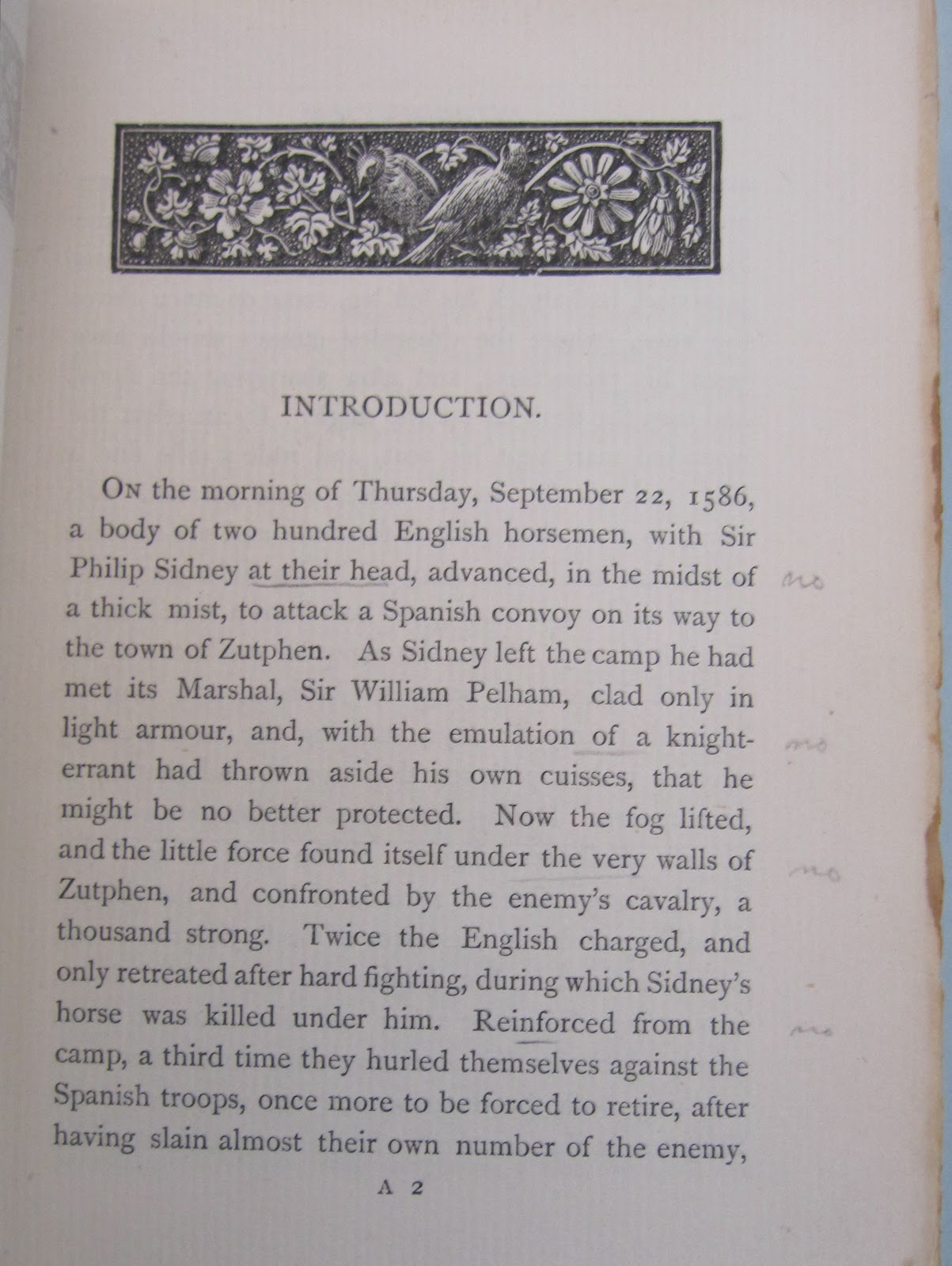
A.W. Pollard, on the other hand, produced "the most conservative and also the best of all the earlier editions" (Ringler 457), partially evinced by the copy's minimal amount of manuscript annotation. To aspects of Pollard's introduction, however, Ringler took exception, especially on several points of Sidney's biography. The four "no"s penciled in the margins (see image above) react to various inaccuracies related the Battle of Zutphen (1586), the event at which Sidney was mortally wounded.
Title page, Feuillerat's edition (1922)
MS notes from Ringler's copy of Feuillerat

If Pollard prepared the best text of the "earlier editions," Albert Feuillerat may have produced the worst. Apparently Feuillerat followed his immediate predecessor (Flügel 1889) in making very poor editorial decisions. Ringler summarizes the situation: "Flügel provided an unhappily inaccurate reprint of Q1, which he wrongly assumed represented the earliest state of Sidney's text...In 1922 Feuillerat, unfortunately following Flügel's mistaken notion of the textual relationships, printed a diplomatic transcript of Q1 with appended variant readings from Bt, Q2, 98, and all subsequent folios, but he provided no analysis of the significance of his variants" (457).

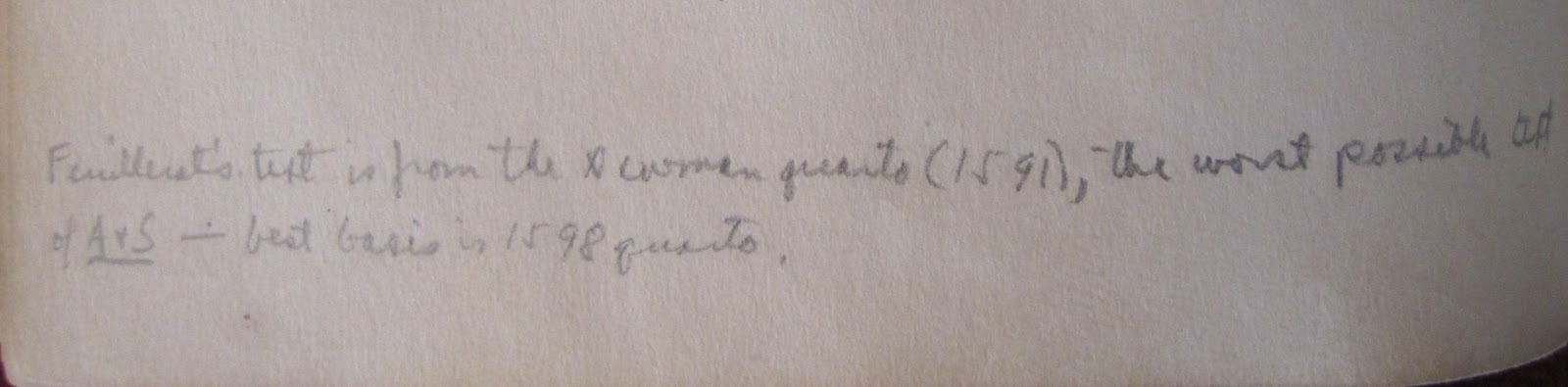
As one can see from the images, Ringler's copy of Feuillerat is the most copiously annotated book from his collection of Astrophel and Stella editions. According to the manuscript note above (last image; taken from page facing the beginning of Astrophel and Stella), "Feuillerat's text is from the Newman quarto (1591) [Q1], the worst possible text of A+S—best basis is 1598 quarto" (I think he means the 1598 folio here, but he could refer to Q3 of A & S, printed [1597-1600]). It is interesting to compare the content and tenor of this MS note to the section quoted above from the 1962 Poems (both of which serve similar evaluative functions); words like "unhappily" and "unfortunately" come off slightly less harsh than the MS "worst possible text."

According to Ringler's color-coded key, the annotations record corrections from Q1 (Feuillerat's copy-text), and variants from Q2, Q3, and "Bt," or, the "Bright Manuscript" (British Library MS Add. 15232). Ringler clearly used his copy of Feuillerat's edition to death, considering the poor state of the binding (see below). 

Mona Wilson's 1930 edition is "based on 98, with 53 emendations from Q1 and Q2" (Ringler 457). Although she wrote a "useful" introduction, Ringler doesn't approve of her "eclectic" method, "her text [being] less close to Sidney's original than Pollard's" (ibid).
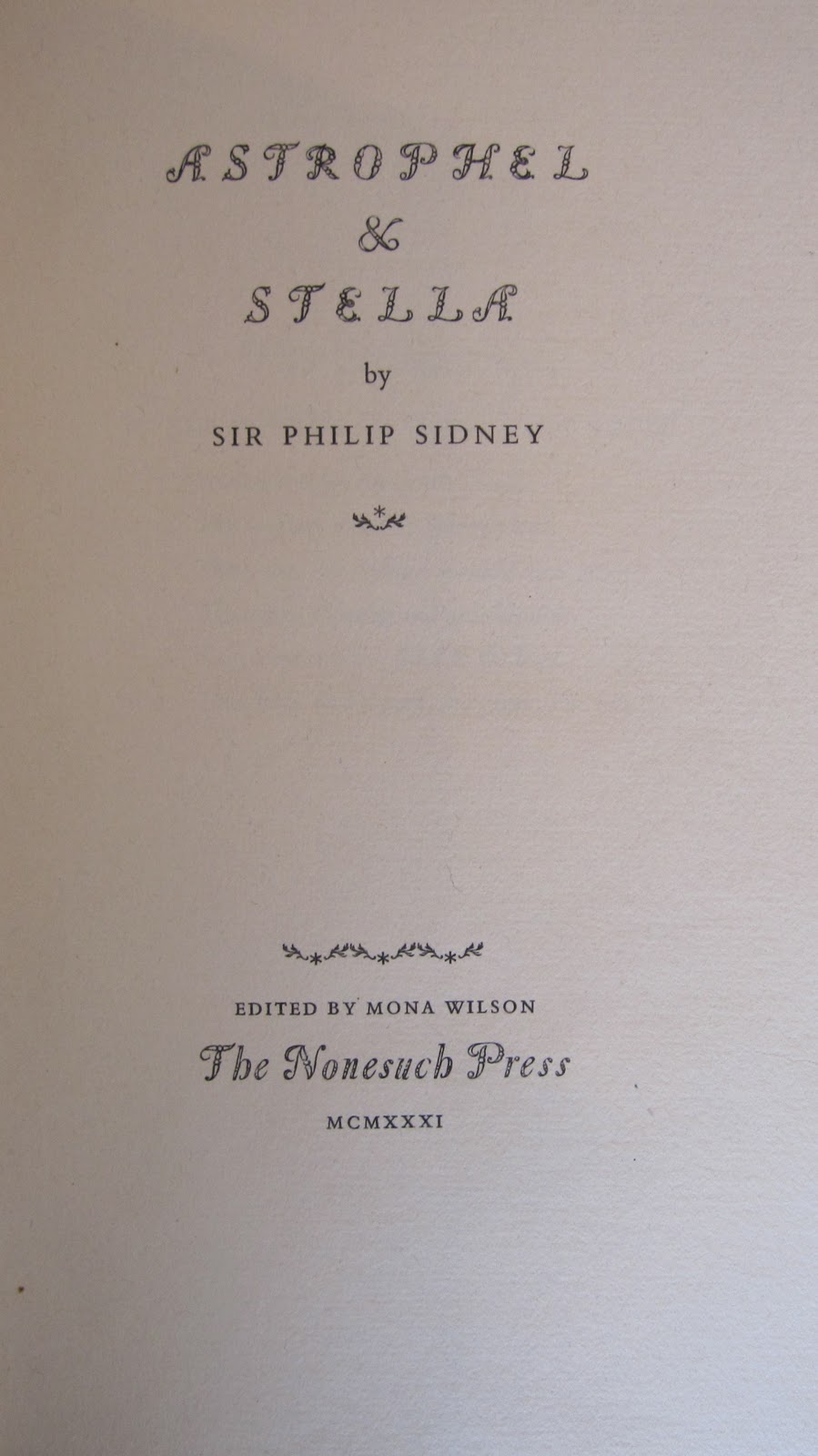

This time without using his typical color-coded system, Ringler notes a number of textual variants in his manuscript marginalia.

Finally, our least annotated but perhaps most personal of Ringler's Astrophel and Stella copies is the French edition prepared in 1957 by Michel Poirier, whose gift inscription to Ringler appears on the half-title.

"To Professor William A. Ringler, with all my best wishes for the completion of his own edition of Sidney's poems. Michel Poirier. December 1957"—a pleasant sentiment, from one Sidney editor to another.

The intellectual labor Ringler invested into these manuscript notes translated directly into his most enduring scholarly work,  the monumental Poems of Sir Philip Sidney. This edition offers an admirable model for any serious editor, and to this day—nearly fifty years after its publication—it remains the standard text of Sidney's poems.


Friday, November 19, 2010

Family Bibles

The Center owns two copies of the “Geneva Bible,” one of the most famous English translations of the scriptures and an enormous influence on Renaissance literature and culture, including the plays of William Shakespeare. As is the case with copies of most old “family” bibles, they contain various examples and genres of manuscript annotation, all of which reflect various social roles of the book. The Bible held an important function for the early modern family (as it has for families in many historical periods), building community through sessions of reading aloud while at the same time guiding the moral and spiritual development of its owners. It also served as an important educational site, especially in the development of literacy; MS annotations consisting of “pen trials” and other forms of handwriting practice found in bibles suggest they were used in this way. The typically extensive and personalized annotation of bibles should also come as no surprise since many households of the time owned only one book, usually a Bible, Book of Common Prayer, or John Foxe’s Acts and Monuments.

Link 
The Bible : translated according to the Ebrew and Greeke, and conferred with the best translations in diuers languages [Geneva Bible]. Imprinted at London: By the Deputies of Christopher Barker, printer to the Queenes most excellent Maiestie, 1598. 
[2], 434, [4], 441-554 leaves; [164] p. ; 23 cm. (4to). STC (2nd ed.) 2171   

Renaissance Center copy has the New Testament of the 1599 Barker edition; in later mottled calf, in phase box; births and baptisms of the children of Richard Palmer are recorded on 3I2v and *1v (dated 1627-1638); signature of Edmund Pell (1719) on 3I2v; inscribed on front pastedown: "Geoffrey Palmer bought at Lampert [?] March 1857"; given to the Renaissance Center by William A. Ringler.

These notes, written in English secretary hand, record the births of various members of the Palmer family in the 1620s, including Richard (the father), and his daughters Anne, Jone, and Avelina. I believe that Richard Palmer wrote the entries and crossed out the first record, which is essentially the same as the third (the birth of Anne Palmer), except for its incorrect birth times. But there is the also the possibility Richard wanted his own entry to hold the primary position in the family records. 

The first two entries (for Richard and Anne) read as follows:

Richard Palmer the soone of Jefferie
Palmer was baptised the x daye of Iunne
in the yeare of our Lorde 1572

Anne Palmer the Dautter of Richard
Palmer was borne at Winge the ffifth
daye of September beinge Wedsonda[y]
betwixte one and Twelfe a Cloke at
nighte: 1627    

blank leaf with ms family records

The second leaf continues with seventeenth-century Palmer family records, including the birth (and death) of his son Charles, along with the death and burial of Avelina Palmer. The records also contain the names of two godfathers (Sir Anthony Coolly and Roger Palmer) and a later ownership inscription from an Edmund Pell, dated 1719.


The Bible : translated according to the Ebrew and Greeke, and conferred with the best translations in diuers languages [Geneva Bible]. Imprinted at London : By Christopher Barker, printer to the Queenes most excellent Maiestie, 1586. 
[2], 434, [4], 441-554 leaves; [164] p. ;  21 cm. STC (2nd ed.) 2145.   
See catalog record for detailed local notes. 


Our other copy of the Geneva Bible, published in 1586, probably contains one of the greatest chronological ranges of annotation of any books in the collection."Robert White of Babworth," whose ownership inscription appears several times throughout the book, appears to be one of the bible's earliest owners. On leaf containing the "preface to the Christian reader" (shown above), he has added an inscription in the period's secretary hand: "Who soeuer heare in doe looke Robert White."


This leaf contains a number of additional early inscriptions, including two more by Robert White ("Robert White Bookee" and "Robert White Booke"). Nicholas and Francis Kent, two men who owned the book in the later seventeenth century, have also added their names, as has a Thomas Hemsworth. In a faint ink at the bottom of the leaf one can just make out a record related to his son Robert (I cannot determine if this is a record of birth, baptism, or burial): "Robert hemsworth the sonne of Thomas hemsworth [????] the [??] of marche."

I wrote about these manuscript annotations in an earlier post. It consists of yet another ownership inscription by Nicholas Kent, who has added an amusing piece of doggerel verse relating to the book.


The three images above depict a series of leaves containing Hindson family records dating to the eighteenth century. The manuscript annotations are fairly standard for family records in bibles, being very similar to the seventeenth-century notes related to the Palmer family I transcribed above. The second image contains not only the Hindson family records but also inscriptions from the book's earlier ownership history, including "Robert" in Robert White's hand and a gift inscription related to the Kents: "John Kent Book given by his Uncle Richard Kent who was Buryed ye 14th day of Aprill, Anno Domine 1671." The third image contains more of the Hindson records, including one related to a family business: "Began to work with my father July 12 1766."


This image contains some of the book's latest family records, related to the Dawbarn family in the nineteenth and early twentieth centuries. Written in a number of different hands and inks, the annotations record births, marriages, and deaths of family members from the 1820s to the 1910s, including Robert Hugh McKay Dawbarn, described as a "noted surgeon." 


The final image bears a gift inscription dated 15 July 1849, when a "Miss Robinson of Newark, England" presented the bible to "Charles Dawbarn of Wisbeck, England." The remainder of the inscription describes the bible's special place within several families during its history:

"This Bible the comfort of 'a family' for many generations, now passes from the possession of its last survivor, with the earnest prayer, that its blessings may rest upon many succeeding generations."


Monday, August 30, 2010

Continental Book Ownership I

Prize Inscription

Daniel van Papenbroeck, Responsio Danielis Papenbrochii ex Societate Jesu theologi ad Exhibitionem errour per Adm R.P. Sebastianum a S. Paulo, ordinis Carmelitani in Belgio bis Provincialem, olim sacrae theologiae professorem Lovanii, evulgatam anno MDCXCIII Coloniae : pars prima ad XII priores articulos.
Antwerp: Hendrik Thieullier, 1696. [2], 2 leaves, 3-318 [i.e. 320], [10] p., 1 leaf of plates : ill., port. ; 23 cm. (4to). Contemporary (?) marbled boards, spine repaired with brown cloth.

This book’s front pastedown offers an example of a prize inscription, a handwritten congratulatory dedication accompanying a rewarded book and often combined with a unique prize binding. Presenting a theological work by the Jesuit Bollandist Daniel van Papenbroeck (1628-1714) to a Hubertus Eelkens of Antwerp, the inscription commemorates and praises the student’s performance in syntax, a class of study commonly offered in Catholic secondary schools and colleges. A note at the end of the inscription illuminates the educational context in which this prize was awarded: “our Turnhout gymnasium” refers to an elite secondary grammar school in Oud-Turnhout, Belgium. While I haven’t been able to identify the exact school (if it still exists), the remainder of the note indicates it was directed by an “R.R. D.D. Can. Reg. de Corssendoncq.” The identity of “R.R.” may remain a mystery at the moment, but the titles accompanying the initials indicate his educational experience (Doctor of Divinity) and devotional affiliation (Canon Regular of St. Augustine, in residence at the Corsendonk Priory). This information places the presentation of the prize book within a specific educational context, one in which Augustinian canons taught secondary-school students syntax and related subjects (such as grammar and rhetoric). As befitting the pomp of the occasion, the majority of the inscription is comprised of a panegyric Latin poem, one praising the virtues of piety and wisdom: 

Palladis ingenuus laudatur ab omnibus ast is

laudandus magis est, qui pietate viget:

Nam recta pietate potens, lætatur utroque

nam pius est doctus quærere regna dei;

Ergo pius doctusque simul, tantummodo docto

præfertur, quoniam solus utrumque tenet.


Other marks of provenance in the book link its ownership to a number of Dutch Jesuit theological libraries in Maastricht, Netherlands.


Ausonius van Popma, Ausonii Popmae, Frisii: De differentiis verborum, libri IV. et De usu antiquae locutionis, libri duo / nunc primum in Germania Magno juventutis bono editi, curante Bartholomaeo Musculo, JC [Hesse, Germany: Josephus Dietericus Hampelius, 1660]

Isocrates, Isocratis Orationes tres : I. ad Demonicum. II. ad Nicoclem. III. Nicocles : cum Plutarchi Chaeronei Paedagogia, seu, De liberorum institutione libello, è graeco in latinum verbotenus in gratiam tyronum linguae graecae translatae, prioribus multò emendatiores : quibus accesserunt Pythagorae Carmina aurea, & Phocylidis Pöema admonitorium, cum versione Michaelis Neandri [Jena, Germany: printed by Kaspar Freyschmidt at the expense of Martin Müller, 1659]
8vo. Contemporary vellum binding. 

A seventeenth-century German owner bound these two texts together and added a detailed index to create a customized philological handbook. Entitled “Index vocum omnium, quarum hoc libro differentiae traduntur” (“Index of all the words, the differences of which in this book are related”), the index was designed to supplement the grammarian and philologist Ausonius van Popma’s De differentiis verborum, a landmark book on synonyms frequently reprinted in the seventeenth century. Its title page has an inscription (dated 1667) most likely belonging to the index-maker and book owner, Johann Betichius of Zerbst-Anhaltini, Germany. This is probably the hymn writer Johann Betichius (1650-1722), who studied theology at the University of Wittenberg (1666-1670s) before serving as pastor of the Trinity Church in Zerbst (from 1689). 


The index and De differentiis verborum are bound with an edition of Isocrates’ (426-338 BCE) orations, a book also containing Phocylides’ Poema admonitorium, the Carmina aurea attributed to Pythagoras, and Pseudo-Plutarch’s De liberis educandis. If the identification of the owner is correct, Betichius acquired these books, bound them, and wrote the index during his academic career. Taken all together, this book demonstrates the academic function of the sammelband as textbook in the educational context of the seventeenth-century German university.