Shakespeare Boiled Down (Chicago: New Home Sewing Machine Co., c. 1890)
31, [1] p. : ill. ; 20 cm.
Shakespeare sold sewing machines—well, at least in 1890s-era Chicago. Issued by the New Home Sewing Machine Company, this rare piece of printed ephemera presents "Shakespeare Boiled Down," i.e. a collection of short, typically single page plot summaries of his plays.
According to the introduction (above), "the intention of this work is to present the reader a clear and concise description of the different plots and characters of all of William Shakespeare's plays." We are told that "great care has been exercised in the wording, so that both young and old can read understandingly." From the introduction it is clear these plot summaries are not intended for first-time readers of the plays, but instead for "those who wish to refresh their memory before witnessing the presentation of any of the plays," i.e. before seeing a theatrical production of Shakespeare.
The summaries themselves are relatively standard accounts of the plays, yet in some cases key omissions reflect the day's sense of literary decorum and good taste. The summary of Titus Andronicus, for example, fails to mention any of the play's acts of atrocious violence: Lavinia is "seized," heads and hands are not chopped off, and no mention is made of the decapitated-head pastries Titus serves Saturninus and Tamora. When the summary mentions Act Five's grisly banquet, it only refers to Titus's curious chef's garb: "to humor a fad Titus dressed up as a cook." According to the summary, Lucius (here named "Mertius" for some reason—probably a nineteenth-century performance practice) at the end of the play "was crowned king, and lived to commit many acts of charity." Clearly this statement ignores his violent executions of Aaron and Tamora. Aaron, his child, and his affair with Tamora are strikingly absent.
There are a few cheap woodcut illustrations of scenes, these from Julius Caesar and Taming of the Shrew. The Julius Caesar summary includes Antony's famous speech ("Friends, Romans, Countrymen") in its entirety.
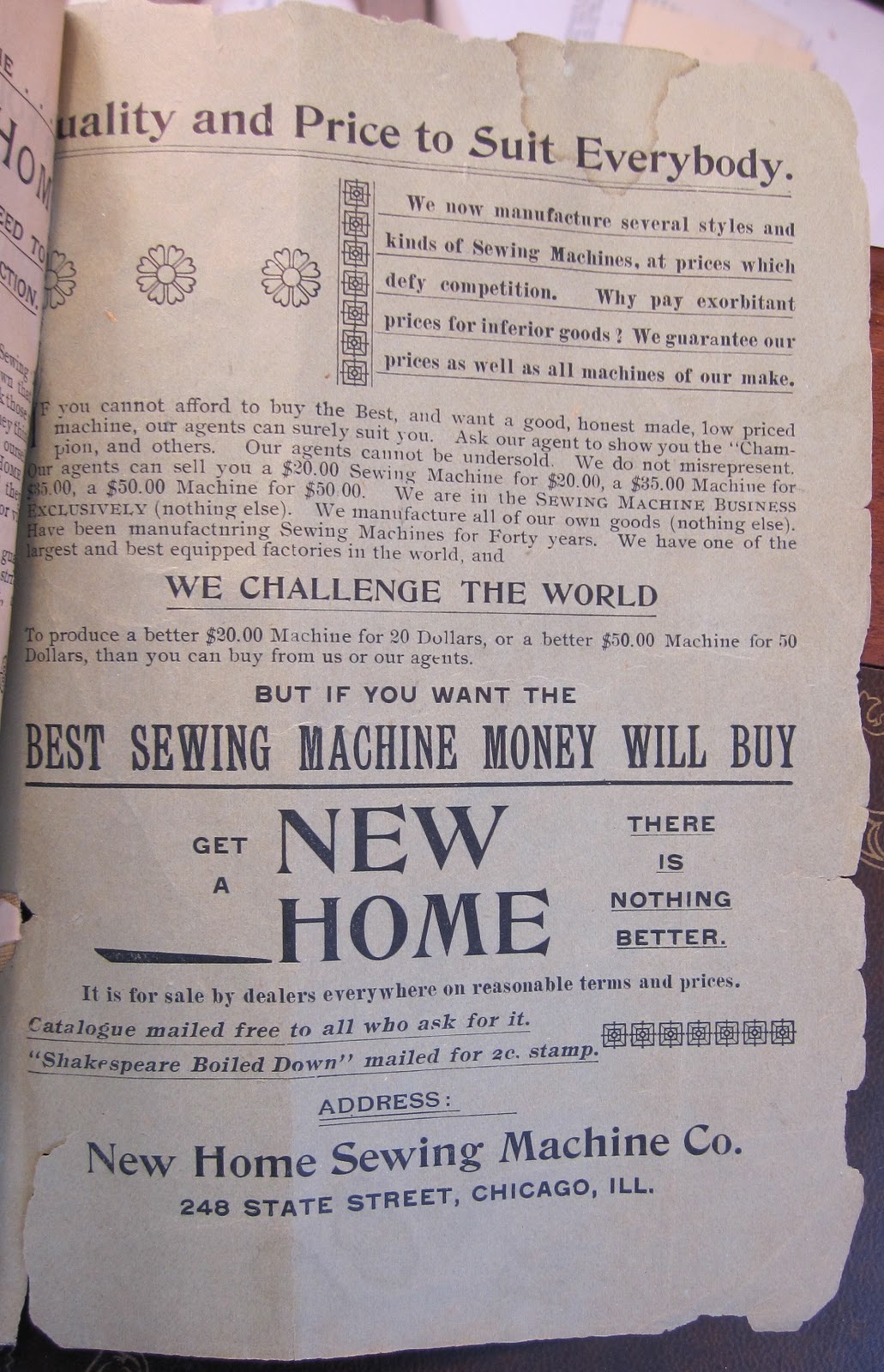
This small and cheaply printed booklet sold for "15 cents," and in some cases—as with the 1893 reprint associated with the World's Fair—it was given away for free. The book was cheaply made, of course, not because the New Home Sewing Machine Company wanted its customers to have an affordable collection of Shakespearean plot summaries, but because they wanted to advertise their products.
At the bottom of this page—from the last of the Shakespearean plot summaries—the reader is told "the NEW HOME advertisement occupies the balance of this book. You have permission to read on if you choose."
These ads comprise the pamphlet's final four pages, marketing not only the "best sewing machine money can buy" (the company "challenge[s] the world to produce a better $20 dollar machine for 20 dollars ... than you can buy from one of our agents"), but also the "drop cabinet no. 9" and the "folding case no. 19," billed as "the very latest...something entirely new." Apparently New Home offers "the only Sewing Machine with a Perfect Double Feed." In the second-to-last image the ad informs customers that the company will send a copy of "Shakespeare Boiled Down" for the price of a 2 cent stamp. The pamphlet's lower cover (the last image seen here) bears the stamp of "Geo. A. Hicks Agent Mt. Pleasant, Mich," presumably the man charged with distributing these booklets and selling sewing machines.
The image of Shakespeare "boiled down" is just delightful.
Here is the complete digital version of the full text, brought to you via Scribd:
Shakespeare Boiled Down
Friday, February 18, 2011
Friday, February 11, 2011
Copy of Allestree's The Ladies Calling with MS poem "On New years day"
Richard Allestree, The Ladies Calling in two Parts, by the author of the Whole duty of man, &c. Oxford: Printed at the Theater, [1705]
[24], 270, [2] p., [1] leaf of plates : ill. ; 20 cm. (8vo).
Renaissance Center copy is in contemporary red paneled morocco (frontispiece lacking; water stains to lower inner portion of pages throughout; leaf 2L4 pasted to rear free endpaper); in phase box; engraved bookplate of Elma Palmer (printed in brown) on front pastedown; signature "Anne Fonnereau Her Book Feb 23d 1755/34" in ink on front flyleaf; signature "Phebe Fonnereau" in pencil on verso of front free endpaper; signature (partly erased) "[---?] Oliver" in ink on verso of front free endpaper; price, not clearly associated with any name, "Pret: 0:2:0" on verso of front free endpaper; ms. poem "On New Year’s Day," mounted on front flyleaf.
This item offers a great example of how early modern readers customized their personal copies of books with unique manuscript content. Two ownership inscriptions link the book to female members of the Fonnereau family in the mid-eighteenth century.
It seems likely that this is the Anne Fonnereau (nèe Banbury, d. 1782) who married Claudius Fonnereau (d. 1785) in 1728; together they had thirteen children, including Phebe, who was born on December 29, 1747. Anne and Claudius had a daughter Ann, but since she was born in 1731, I doubt it is she who left the inscription. It is also possible this is Anne Fonnereau, ("my father's wife" in Claudius's words), who he describes as a "Grand Mother" in 1738. This information comes from MS records in a bible related to the Fonnereau family; its contents are transcribed in Joseph Jackson Howard, ed., Miscellanea genealogica et heraldica, Second series, volume 5 (1894), 281-3.
The manuscript poem affixed opposite the title page, entitled "On New years day," seems to suggest the book was presented as a New Year's gift; the genre of the New Year's gift poem was quite commonplace and fashionable at this time, and the book's beautiful red goatskin binding suggests it may be a presentation copy.
But the content of the poem itself does not focus on the act of giving, nor does its speaker (presumably the gift-giver) mention a gift-recipient.
On New years day
Another year, my soul, is past
This I’ve begun may be my last
Think then O think my soul how soon
Wether, in Morning, Night or, Noon,
The solemn howr of death you hear
That call so awful met with fear
Will seal the sentence from that voice
At which the Righteous will rejoice
With fervent prayer May I receive
The blessings Christ alone can give
Jesus. to Thee I humbly bow
From whom the gift I crave must flow
That Saving Name Which Thou didst take
This Day for Man’s eternal sake
O: Let it be to me in heart
That Life Which Thou can well impart
From this day Make me live to Thee
O Holy blessed Trinity
And never more abuse Thy dove
But fix my heart on things above
Renounce the world & every sin
Have life & holiness Within
For Mercies great [?] on Every day
My grateful Praises constant pay.
Rather, the poem is intensely personal and devotional in nature, seemingly written by an older person who feels closer to death with each passing year ("This I've begun may be my last"). The images evoke a close personal and spiritual relationship between the speaker and Christ that is built upon prayer, meditation, and divine blessings.
I am fairly certain the poem is in the hand of Anne Fonnereau, who left her inscription on an endpaper, although the subject matter of the poem suggests the poet may be the "Grand Mother" Anne Fonnereau, who would have been an old woman at this time.
I have been unable to identify the Elma Palmer whose wreath-and-ribbon style bookplate is displayed on the book's front pastedown. I suspect that the manuscript price (pret: 0-2-0, or 2 shillings) found on one of the endpapers refers to the book's second-hand value.
Friday, February 4, 2011
Hollar etchings for Ashmole's book on the Order of the Garter
| title page |
| Bookplate of Clements R. Markham, with notes |
Elias Ashmole, The Institution, laws & ceremonies of the most noble Order of the Garter. London, 1672
Renaissance Center copy is in modern half brown morocco and brown cloth; license-to-print and errata leaves wanting (supplied in facsimile); errata list also supplied in ms.; armorial bookplate of Clements R. Markham on front pastedown; mounted on front pastedown is a ms. note (perhaps extracted from a list of bequests?): "Fellowes. To Lilian Mrs. Fellowes daughter of my dear old messmate and friend Sir Vesey Hamilton. 1. Ashmoles Knights of the Garter [i.e. this work; followed by two other titles, both by W.H. St. John Hope]"; the note is likely by Markham, as both Hamilton and Markham served in HMS Assistance (DNB); laid in is a small sheet headed: "Some errors in the engraved coats-of-arms [at p. 708 ff.] noted by Reginald Courtenay in Feb. 1928.
Thus far I have used these blog entries to write about items absolutely unique to the Renaissance Center's collection, that is, books with manuscript material, identifiable provenance, or one-of-a-kind bindings. But today's entry centers on a printed book, one that is not unique to our collection, yet one that because of its remarkable qualities nevertheless deserves our attention. Its illustrations particularly deserve our attention (and reproduction through digital imagery), for they are some of the most beautiful plates ever produced by the etcher Winceslaus Hollar.
The book is Elias Ashmole's The Institution, laws & ceremonies of the most noble Order of the Garter, an impressive folio volume that describes its subject in over seven-hundred pages of carefully prepared antiquarian detail. Elias Ashmole was known variously as an astrologer, alchemist, and antiquarian, and in this latter capacity helped catalog the curiosity cabinet owned by the Tradescant family of Lambeth, a collection that would form the cornerstone of Oxford University's Ashmolean Museum. A staunch Royalist, Ashmole conceived of The Institution in the 1650s, a time when he feared that the long-standing and prestigious Order of the Garter (the founding of which is most commonly attributed to King Edward III) would slip into oblivion. The Order the Garter is Britain's most exclusive chivalric order, the members consisting solely of the monarch, Prince of Wales, and no more than twenty-four other noblemen. Ashmole intended his book as a "formulary" for the various practices and customs associated with the Order, and he hoped the extensive antiquarian and heraldic research he poured into the book would preserve those customs for posterity.
If the idea for the book began in the 1650s as a way to sustain Royalist and elite English culture in the absence of monarchical government, the book's post-Restoration publication in 1672 coincided with a reestablishment of the king's power and the Order itself, that "quintessentially Royalist cult" as Michael Hunt describes it (DNB). It may come as no surprise, then, that the book begins with a full-page engraving of Charles II (signed by William Sherman).
To round out the Institution's information about the Order's customs and ceremonies, the etcher Winceslaus Hollar was commissioned to create dozens of illustrative plates. These etchings are beautifully executed and amazingly detailed in their depiction of various buildings, material objects, and ceremonies related to the Order of the Garter. Even the book's historiated initials are beautifully illustrated, as seen in the images below (depicting St. George and the dragon, a symbol vital to the Order's iconography).
Hollar was well known for his etchings of buildings and churches, especially his ability to represent even the minutest of architectural details. The following images of St. George's Chapel at Windsor Castle—some of which appear in the book as folding plates—will give you a sense for Hollar's skill in this regard.
These images are also interesting because they depict a newly restored St. George's Chapel, a building which had suffered much damage at the hand of Parliamentary armies during the Civil War. While these images depict a empty space others outline the various processions and ceremonies the Order would perform within such spaces. The fourth image's depiction of wall tapestries in St. George's Hall is truly stunning in its detail.
| detail of previous image |
Many of Hollar's plates illustrate the variety of material objects—most of them ornately decorated—that the Order of the Garter used in its elaborate ceremonies. The first image depicts objects worn by all Order members, such as the garter, collar, hood, surcoat, and feathered cap, as well as the "sovereign's mantle" worn only by the monarch.
This next image shows "the ancient habits and ensigns assigned to the Officers of the Order" juxtaposed against "the present habits, ensigns, and badges" of those same officers. The following images depict other badges worn by members of the Order.
Two other objects associated with the Order's ceremonies include the "bag of the seal of the Garter" and the "book of the seal of the Garter," both of which are shown below.
Finally, the book's plates also depict scenes related to European monarchs and their "investiture" into the Order of the Garter, as part of a chapter on "the investiture of strangers." The plate below shows "the manner of sitting at dinner" performed by Maximilian II (of the Holy Roman Empire) and King Ferdinand II of Spain during their feasts of investiture.
Probably my favorite image in the whole book also comes from this chapter. During the investiture of Charles XI of Sweden in 1668 (at Stockholm), his court put on an elaborate fireworks display to celebrate the conferment of this signal honor. Etchings of fireworks are simply beautiful, and this plate is no exception. There is something about the contrast between the light of fire and darkness of night that I find so striking in these images. As such, this delicate composition between light and dark is easily lost in poor photographic reproductions; the EEBO image of William Marshall's brilliant engraving of Egyptian fireworks in George Sandys' A Relation of Journey (1615) is a prime example. Here are Hollar's etchings of the Swedish fireworks:
| detail |
| detail |
To accompany the etching we have Ashmole's detailed description, which outlines the elaborate fire- and water-works shown in the image:
"The Fire-works above mentioned, which the King of Sweden caused to be prepared, to close the Solemnity of his Investiture, and manifest to the world his great satisfaction in the honor received, were ordered in the following manner. In the middle of the work was erected a great Pillar 52 foot high, on the top of which was placed a gilt Crown; 18 foot below the Crown were the initial Letters of the Soveraign's and King of Swedens Christian Names, set breast to breast: and below at the Foot were placed several Military Colours, both of Horse and Foot, filled with Fire-works. This Pillar stood in the middle of four antique Trophies, filled with Fire, and upon each side of the Pillar, 40 foot distance from it, was placed St. George on Horseback, having the Dragon under his Feet, of 24 foot in length, and 28 in heighth, and on each side of St. George two Pyramids of 36 foot high. In several places of the Work were set great Wind-Pipes, filled with Water, for playing of Water-Balls, and round the Work about 2000 Musket-Pipes, 60 together in a Frame, with 72 Chests in and about the Work, full of Rackets 12 foot high, besides 28 Chests with Swarmers in the Earth, 2 foot high; and above 1000 Pattroles fired by Degrees, which flying high threw from them all sorts of Figures of Fire. Lastly, at each corner a Fire Murser, which threw up all sorts of pleasant Fire-Balls, and in their breaking presented several figures" (423-4).
Hollar etched another image of fireworks based on a display he saw in Hemissem, Belgium, which you can see at the University of Toronto's spectacular digital collection of Hollar etchings.
I hope that the images I've provided above do justice to this beautiful book, yet I still encourage you to see it in person if you can, for it is truly a remarkable piece of craftsmanship, not only in its marshaling of a vast body of antiquarian knowledge, but also in its composition as a material book.
Friday, January 28, 2011
Seventeenth-Century French Devotional Manuscript
After weeks of writing articles for the Renaissance Center's newsletter and installing our latest rare book exhibit (on early modern emblem books), I can finally turn my attention to the blog and its long overdue first post of 2011. The subject of this post is a recently acquired bound sammelband, composed of several French devotional texts in both print and manuscript.
Divers Traitez povr la vie spirituelle, & religieuse. À Bray. 1665
Contemporary blind-stamped calf; spine decorated in blind with five raised bands; contemporary [?] metal-clasps; French nonpareil marbled endpapers. 16 cm (8vo).
Entitled "diverse treatises on the spiritual and religious life," this handy book is a sammelbande of devotional texts and prayers compiled at Bray-sur-Seine, France in 1665. The book is divided into three main sections: the first contains four carefully written fair-copy texts, the second contains part of a printed pamphlet, and the third contains several leaves of miscellaneous devotional materials in MS, primarily prayers. The scribe decorated the fair copy texts with beautiful hand-drawn ornamentation.
The contemporary calf binding has two metal clasps that probably date to the same time as the composition of the sammelbande. The nonpareil endpapers correspond to the kind used in seventeenth-century France, further suggesting that the binding of the book dates to the same time as the writing of the text. While we have no clues as to the identity of this book's compiler, an endpaper with ink-obliterated gift inscriptions may provide some clues. I am in no way an expert on French paleography or the French language, but I believe the inscription reads "ce livre apartien a ma soeur de la villerobert [?]," or "this book belongs to my sister of [???]." Although I haven't identified what I've transcribed as "villerobert," I think it is clear this book belonged at one point to a nun, probably in a convent near Bray-sur-Seine.
The fair copy manuscript texts with which the book begins look like they have been copied from printed books, yet we have not been able to find any printed books that correspond to these titles or their texts. The four texts in question—“Maniere d’entendre la Messe” (the way to listen to the mass), “Discovrs sur la Perfection requise en l’Estat Religieux” (discourse on the perfection demanded in a religious state), “Discovrs de la vie Interieure, Religieuse, & Spirituelle” (discourse of the interior, religious, and spiritual life), and “Discovrs et Exhortation du vray Nouiciat” (discourse and exhortation of the true novitiate)—seem to have been custom-written and copied for the book's audience, although the subject matter details somewhat commonplace knowledge about devotional practices that certainly appears in other printed books and manuscripts.
According to the title of the second and third texts, we are told they were "fait par Messire Octaue de Bellagarde Archevesque de Sens," that is, made for Archbishop Octave de Saint-Lary de Bellagarde, who served as the Metropolitan Archbishop of Sens, France from 1621-1646. The scribe has provided a colophon at the end of the second text which dates its transcription at Bray-sur-Seine to 1665, and indicates that the original writing of the text was completed on July 29, 1620. So it seems like this Archbishop commissioned the writing of these two devotional guides, and at one point manuscript examplars of these texts existed.
The portions of the book in fair-copy feature a number of intricately penned ornaments adorning the text. These seem to be executed in imitation of printed ornamentation, although the detail in the MS drawings is much more fine and intricate. The scribe does not repeat any of the ornaments twice, and at several points adds very ornate drawings to the ends of the individual texts (as seen below).
I still think it is likely some of this ornamentation was copied from printed books, so if anyone recognizes any of these designs please let me know!
The fragmentary printed book that occupies the structural center of the composite volume is exceedingly rare. The text is Pierre de Bérulle, Claude Cayne, and P Jujart, Lettre aux religieuses de l'ordre de Nostre Dame du Mont-Carmel, érigé en France, selon la première observance; Par Monseigneur l'Illustrissime Cardinal de Berulle, leur Superieur et Visiteur. S.l: S.n, 1644. The copy is imperfect, missing A1 and everything after C4, but it is the only copy I could find other than the one held by the Bibliothèque Municipale de Lyon. These letters to the nuns of Notre-Dame du Mont-Carmel—which according to the book's subtitle were intended in part "authoriser le formulaire qu'elles doivent suivre" (to authorize the formula that they must follow)—nicely complement the fair copy texts in their emphasis on the proper way to conduct one's life in a religious order.
Finally, the volume's concluding leaves form a devotional manuscript miscellany, written far less carefully than the MS texts with which the book begins. As you can see from the images above, this section contains writing in various hands and inks, corresponding to notes and prayers undoubtedly written down at different points in time. If the fair-copy and printed texts that begin the book provide a codified and carefully prepared guide to the "spiritual and religious life," then the miscellany that ends the book seems to be space for collecting prayers and litanies that the book's owner learned elsewhere. This section contains an “oraison a Sainte geneviesue patrone de paris” (Bray-sur-Seine and the Archbishopric of Sens being close southeastern neighbors of Paris), the Litany of St. Bernard, “litanies de notre pere sains francois de salles," and “litanies de la bieu heureux jeanne francoise fremiot de chantal.”
As one of our few bound manuscripts, I am excited to have this book in our collection and would love to conduct more extensive research into its producers and owners, as well as the religious communities/networks through which it might have passed. Information is welcome.
Subscribe to:
Posts (Atom)