Friday, April 1, 2011

"Madam St. Andrew," a Royal visit to Wolverhampton, and Manuscript Clues in Printed Books

According to an anecdote from Wolverhampton (Staffordshire, West Midlands) local history, King Charles I visited the city in 1643 shortly after the Battle of Hopton Heath (19 March 1642/3). There the king stayed at a private residence, where he "was entertained by Madam St. Andrew, a near connection of Mr. Gough" (Burke, Genealogical and Heraldic History, II.393). According to Stebbin Shaw, this "Madam St. Andrew" was "either sister or aunt to Mr. Henry Gough" (History and Antiquities of Staffordshire), a prominent local landowner and Royalist. For the rest of the anecdote I direct you to Burke. But to summarize it briefly, it appears that Henry Gough publicly denied the King any financial support for his military campaign, only to visit him privately at night (much to the alarm of the King's guards) with a large monetary gift (£1200 according to Burke's note). Charles was apparently so impressed with the gift that he proffered to knight Gough, who politely and humbly declined this signal honor. 


So what is the connection between this anecdote and our collection of rare books? The answer lies in the mysterious identity of this "Madam St. Andrew," who may have owned one of the books in our collection. 

(As a side-note, the house she lived in while harboring the king would become an inn—the "Star and Garter"—in the eighteenth century. See this page for more on the "Star and Garter.")

John Speed, The historie of Great Britaine under the conquests of the Romans, Saxons, Danes, and Normans. Their originals, manners, habits, warres, coines, and seales, with the successions, lives, acts, and issues of the English monarchs from Julius Caesar, unto the raigne of King James, of famous memorie. 
At London: Printed by John Dawson [and Thomas Cotes], for George Humble, 1632. 
[22], 1042 p., 1043-1086 numb. ℓ., 1087-1237, [85] p.  illus., geneal. tab. (port.)  35 cm (folio). 

One of our two copies of Speed's Historie contains several interesting marks of seventeenth-century provenance. The first seems to read "Henry Syrott" [?], but I have been unable to identify him.

The next one seems to allude directly to the anecdote about "Madam St. Andrew," the Goughs, and Charles I cited above.

"John Goughe his booke,
given him by his Aunte:
mrs Elyzabeth St andrewe"

According to Shaw, "Madam St. Andrew" was either the sister or aunt of Henry Gough, who was the father of John Gough (his ownership inscription is possibly shown here). The signature of "Elizabeth St. Andrew" appears at the rear of the volume on a strip of vellum used to reinforce the binding.


If this is in fact the same "Madam St. Andrew" who was "sister or aunt" to the Henry Gough in the above anecdote, then John Gough's ownership inscription seems to establish that she was in fact his aunt, and therefore Henry's sister. 

On one of the rear endpapers someone transcribed (in a careful italic hand) part of Francis Quarles's epigram "On Fox" (i.e. John Foxe, writer of the Protestant martyrology Actes and Monuments--major edns. in 1563, 1570, 1576, and 1583). According to the Folger First Line Index, this poem appears in only two other places: Quarles's Divine Fancies (1641; Wing Q62, p. 101) and BL Harley 2311, f. 20. The version of the poem transcribed here (probably in Elizabeth St. Andrew's hand) is missing the last two lines:


Transcription: 

there was a tyme woe worth that heavye tyme
when wolvish foxes did devour the prime
and choyce of all our lambs. but heaven did raise
a most ingenious foxe in after dayes
whose high immortall penn redeemd their breath
and made there names to live in spight of death

The last two lines (present in both Divine Fancies and the Harley MS) read:

To see, how mutuall Saintly favors be!
Thou gav'st them life, that now give life to thee.

There are other interesting variants between the printed poem in Divine Fancies and the transcribed fragment shown here. The printed version reads "rav'nous foxes" for "wolvish foxes" and "made those lambs revive" for "made there names to live." Since the ms version doesn't contain the final two lines, I doubt Elizabeth St. Andrew copied the poem from Quarles's printed book; I think it is likely she copied it from another manuscript source. 

Coincidentally, the city of Wolverhampton opens an exhibit on its royal visitors tomorrow, but it doesn't mention Charles' visit in 1643.
 

Friday, March 25, 2011

Customizing Camden III

This will be the third and final post on "Customizing Camden," a multi-part series of entries I began three weeks ago that presents images and commentary on the Center's collection of annotated books written by the antiquary William Camden (1551-1623). Today I will focus on two books formerly owned by major figures in early modern England, the London stationer Humphrey Robinson and the Professor of Music at Oxford from 1661-1682, Edward Lowe. 


William Camden, Annales rerum Anglicarum et Hibernicarum regnante Elizabetha. Lug. Batauorum [Leiden]: Ex officina Elzeviriana, MDCXXV [1625]. [16], XVI, 855, [41] p. :  port. ;  18 cm. (8vo). 

Renaissance Center copy is in contemporary calf (lacks portrait); in phase box; inscription on front free endpaper: "Ex dono charissimi amici mri Humphredi Robinson Stationarij Londinensis. a. d. 1627. R.E.", and ms. initials "R.E." on title page; armorial bookplate of J. W & O. Farrer and stamp of the University of Illinois Library on front pastedown; bookseller’s description and invoice (of C.A. Stonehill) to William A. Ringler, Jr., laid in.

First published in 1615, Camden's Annales was the first biography of Queen Elizabeth I. This copy of the 1625 Elzevir edition contains not only the work's first three parts (completed in 1615), but also its fourth (completed in 1617), which Camden instructed his friend Pierre Dupuy of Leiden to publish only after his death (Herendeen, ODNB).

The book was formerly owned by "J.W. and O Ferrer," whose "die-and-sinker style" bookplate (popular in the nineteenth century) sits alongside the ink stamps of the University of Illinois (at Urbana-Champaign) library. 

While the bookplate and stamps may strike one as rather typical marks of provenance in antiquarian books, this gift inscription (on the front free endpaper) is a rarer bird, documenting the book's association with Humphrey Robinson (d. 1670), one of seventeenth-century London's most important and prolific bookseller-publishers. 

The inscription reads:

Ex dono charissimi amici Mri Hum=
phredi Robinson Stationarij
Londinensis. a.d. 1627
                                         R.E.

Translated:

From the gift of [my] dearest friend Mr. Humphrey Robinson of the London Stationers. a.d. 
1627

It may be impossible to determine who "R.E." was (I eagerly invite speculation), but the inscription nonetheless documents the gift-giving activities of an important stationer in the first few years of his full company membership (he became a freeman in 1623). Robinson's career spanned nearly fifty years (1624-1670), during which time he produced such eminent literary works as the Beaumont and Fletcher first folio (with Humphrey Moseley, 1647), John Milton's A Masque presented at Ludlow Castle [Comus] (1637), and Francis Bacon's Essays (1669). As was customary with gift inscriptions of this kind, the text here was written by "R.E.," the recipient of the gift, rather than Humphrey Robinson, the gift-giver. I believe the manuscript price ("4s") is in a different hand, and may have been a retail price associated with the London book trade. 

William Camden, The historie of the most renowned and victorious Princess Elizabeth: late Queen of England: contayning all the important and remarkeable passages of state both home and abroad, during her long and prosperous raigne: composed by way of annals: neuer heretofore so faithfully and fully published in English. 
London: Printed for Benjamin Fisher and are to be sold at his shop in Aldergate streete, at the signe of the Talbot, MDCXXX [1630]. 

[22], 138, 120, 104, [6], 105-148, 224, [20] p. :  port. ;  28 cm. (fol.)

Renaissance Center copy is in contemporary (?) calf (lacks Aaa⁴; hinges split at top; final leaf torn); signature "Ed: Lowe" on recto of pi1 and "Edwd. Lowe" on inside front cover; earlier signatures "Richard Whyting [?]" and "John [---]" on recto of pi 1 are partially obliterated in ink; ms. notes on front free endpaper, including "Second hand Cost 4s 2d" in an early hand.  

This 1630 translation of the Annales, "neuer heretofore so faithfully and fully published in English" as the title advertises, contains several interesting manuscript notes dating to the seventeenth century. 


The first of these two inscriptions (the one partially obliterated by ink) appears to read "Robert Whesting." I have been unable to identify him. The second inscription, on the other hand, belongs to Edward Lowe (c. 1610-1682), who served as Professor of Music at Oxford University from 1661-1682. His italic hand and signature survive in a number of contemporary music MSS held in UK institutions. A less stylized version of his signature, from a music manuscript at the British Library, can be seen here.


Lowe also signed the book's inside front cover. 

Perhaps the most interesting manuscript writing in this copy of The Historie of Elizabeth appears on the front free endpaper, a page bearing a number of signatures, scribbles, sums, and notes. I haven't fully worked out the manuscript notes on this page, but there seem to be at least three (probably four) different hands at work. The "Robert Whesting [?]" who signed [pi]1r seems to have begun his signature at the very top of this leaf, to the right of the sum that comes out to 15:0:5. The descender of the majuscule "R" he uses looks very similar to that of the "R" in the note reading "A Receipt" near the edge of the page (both shown below).


Near the top center of the page, in a different hand, a "John W [...]" started to sign his name. In the bottom left-hand corner of the page, in yet a different hand, is a note recording the book's second-hand price: "Second hand / Cost 4s:2d" (shown below).

Finally, in the page's messiest secretary hand (possibly by "John W."), there are a series of notes that appear to relate to someone borrowing the book. 

The annotator begins this note twice (upper center of the page)—"This vnto" and "The Co" —before committing to the substantial note in the page's right center. 

The note itself (marked by two heavily inked vertical lines) reads:

Condicion (of this obligacion)
    is such      s
                               this vnto her returne
                               I affecte as deare
                               as my owne heart
                               yet that receue 
                               mee neare                       

(Special thanks to Heather Wolfe for helping with the transcription.)

The note seems to outline a situation in which someone (probably a lover) was required to return a book to an unknown woman ("her") who the borrower "affecte[d] as deare / as [his] owne heart." This note, along with the book's other manuscript additions, afford us with brief but tantalizing glimpses at both the second-hand book trade and the social practice of book lending in early modern England.

That does it for this week's post and the "Customizing Camden" series. Hope you have enjoyed the entries.

Friday, March 11, 2011

Customizing Camden II

Continuing with the focus of last week's post, today I'll write about a few more of our copies of works written by the antiquary William Camden, all of which contain unique manuscript content added by former owners. Last week I highlighted our two copies of Camden's Remaines, especially how owners added their own manuscript epitaphs, proverbs, and apothegms to the printed book. Today's examples deal more specifically with provenance and ownership inscriptions.

Britannia, sive, Florentissimorum regnorum, Angliae, Scotiae, Hiberniae, et insularum adjacentium ex intima antiquitate chorographica descriptio. Londini: Impensis Georg. Bishop [at the Eliot's Court Press], 1590
[16] 762, [22] p. : Ill. : 19 cm. (8vo). STC  4505

Renaissance Center copy is in contemporary calf (head and foot of spine, and back hinge, torn; several leaves lacking: C1, 3D1, and 3D8); signed on rear flyleaf: "Thos Charles’s book"; a fragment of a printed (incunable?) bifolium is inside back cover, under the turn-ins; a similar fragment appears to be undeneath the (later) front pastedown; stamp on title page and p. 299 of the Theological College, Bala, noting it as from the library of the late principal, T. Charles Edwards.

The purple stamp on the title page places the book in the library of Thomas Charles Edwards (1837-1900), a Welsh minister who held the post of Principal at the University College of Wales, Aberystwyth. Dated May, 1900 (two months after Edwards' death), the stamp is associated with the "Theological College, Bala," (Bala, Gwynedd, Wales) a school that Edwards helped found. 

At an earlier point in history (probably the eighteenth century) a "Thomas Charles" owned the book, as can be seen in this manuscript inscription. 

Perhaps shortly after the book was printed, a book craftsman used a fragment of a bifolium (perhaps an incunable) to strengthen the binding. I have been unable to identify the text as of yet.


Britannia, sive, Florentissimorum regnorum, Angliae, Scotiae, Hiberniae, et insularum adjacentium ex intima antiquitate chorographica descriptio. Londini: [at Eliot's Court Press] per Radulphum Newbery, 1587. 
[16], 648, [24] p. : ill ; 17 cm. (8vo). STC 4504


Renaissance Center copy is in contemporary vellum (portion of backstrip detached, revealing ms. waste in binding; detached piece laid in at back); in phase box; several ornamental initials have been hand-colored, probably much later; signatures on title page: "Jos.a Dobson" and "Carolus [Fynn?] Anno 1771"; some random pen-trials.

This title page of this book bears two ownership inscriptions: "Jos.[eph] a. Dobson" and "Carlous [Fynn?] Anno 1771." While one cannot determine this for certain, it is likely one of these two owners hand-colored several of the book's ornamental initials.

It is unlikely this hand-coloring is contemporary, but considering the late eighteenth-century provenance on the title page it is still possible that this decoration was added several hundred years ago. The colored initials display a variety of inks and paints; I detect no fewer than seven different pigments in this capital "A" for instance. 


The "N" shown here is outlined in gold paint and bears an equal variety of pigments and inks. 

From this broader vantage point, one can see how the color really enhances the aesthetic appearance of the book. 


Unfortunately due to time constraints I will have to wait until the next post to talk about our two Camden books with the most interesting early modern provenance (related to Edward Lowe, seventeenth-century Professor of Music at Oxford University; and the London stationer Humphrey Robinson). I'll be away from the blog next week, but expect "Customizing Camden III" on the following Friday.

Friday, March 4, 2011

Customizing Camden I

As some of the period's best-selling works of English history, the printed books of the antiquary William Camden—most notably the multiple editions of Britannia (1586) and Remaines concerning Britaine (1605)—appeared in early modern bookshops with particular abundance, and have consequently survived in a relatively large number of extant copies. The Center owns fifteen copies of Camden's works printed between 1587 and 1751, including six copies of the Britannia and two each of the Remaines and Annales. 

Today's entry and a continuation next week highlight the numerous manuscript annotations and additions owners left behind to customize their copies of Camden's works. While the body of manuscript content found within these books is miscellaneous at best, by anchoring a study of these unique additions within the context of Camden's printed record certain patterns of use begin to emerge. Below I will discuss our two copies of Camden's Remaines and how readers augmented them with specific manuscript additions. 


William Camden, Remaines concerning Brittaine: but especially England, and the inhabitants thereof: their languages, names, syrnames, allusions, anagrammes, armories, moneys: empresses, apparell, artillerie, wise speeches, proverbs, poesies, epitaphs. London: Printed by A.I. for Symon Waterson, 1629.
[4], 9, 8-346 p. ; 19 cm. STC  4524
Renaissance Center copy is in modern half calf and brown cloth; signature "Ob: Ghossipp" on title page; some ms. annotations, including additional proverbs.

If Britannia contains the most important points of Camden's antiquarian research, the Remaines offers an overflow of information—mainly items of linguistic curiosity—collected during his extensive travels. As Wyman H. Herendeen summarizes, "[w]ith the first historically organized anthology of medieval poetry, a historical and comparative study of the English language, collections of names and their meanings, of (in the words of one of the chapter headings) ‘grave speeches, and wittie apothogemes,' and of epitaphs, it can be seen as a popular spin-off from its more expensive and serious historical mother lode, the Britannia" (ODNB). The Remaines is essentially a vast print miscellany structured around specific forms and genres, and this format may have invited readers to add their own epitaphs, poems, apothegems, proverbs, etc. 

The manuscript notes and additions in this copy (the fourth edition) were apparently written by the "Ob: Ghossipp" who signed the title page, a reader who sought to augment Camden's study of the English language with new apothegms, "wise speeches," and proverbs. In the (unfortunately cropped) marginal notes above, our annotator responds to Camden's discussion of English punning, especially the word "agnominations," which is underlined. A rough reconstruction of these notes reads "Nicknames [...] more [p]roperly [...] Sr John [...] defines [...] Allusion [...] one word [...] another [...] resemblance [...] sound." It seems that the annotator adds a gloss of "agnominations," buttressing Camden's work with personal knowledge. The second note "[..]hen heart, [ol]d fellow, Coward" refers to the underlined word "Niding," which the printed text defines as "base-minded, false-hearted, coward." Both annotations illuminate the philological study of curious English words.


The annotator's most notable textual interventions take the form of additional proverbs and "wise speeches" inscribed in the book's blank spaces. In the first image, our annotator adds an apothegm or "wise speech": "Captain Gamme at the Battell of Agincourt beinge / sent by the K[ing] to discouer the number of the enimies brought / him word there were ynough to be slaine, enow to be taken / prisoners and enow to runne away. Sr W.R." 
  
The additional proverbs include "agree like harpe and harrow; Dr Abb."; "Goe saith the King, stay saith the tide Sr W:R:"; and "many things fall betwixt the cup and the lipp." "Sr W:R:" is presumably Sir Walter Raleigh.

William Camden, Remaines concerning Britaine. London: Printed by Thomas Harper, for John Waterson, 1636. 
3 p., ℓ., 420, [2] p. :  front., (port.) illus. (coats of arms)  18 cm. STC 4525. 

The next edition of Remaines was published in 1636 by John Waterson, and introduced the engraved image of the author shown here. The title page bears two marks of provenance, the roughly contemporary looking initials "L.J." (or "E.J."), and an early nineteenth-century inscription that reads "Hen: A: Merewether Calne, Wilts[hire] Friday May 30th, 1806 / Nb This was one of my uncle's Books. & given to me by my Brother Francis." 

The front pastedown bears Merewether's (1780-1864) armorial bookplate, along with the inscription "John Wickins 1756" and a manuscript price of "2s." 

On the facing endpaper (probably in John Wickins' hand) is the "Saxon Alphabet," which was probably copied and slightly modified from the "Alphabetum Anglo-Saxiconicum" that accompanied printed copies of the Britannia, as shown below.

Like the annotator of the 1629 Remaines, here a former owner has augmented Camden's collection of verse and sayings with three manuscript epitaphs.

The second epitaph, on "Mr Fenton," was written by Alexander Pope, and also appears in BL Add. MS 28101, f. 115. I have been unable to locate the other two in the Folger-hosted Union First Line Index. 

Stay tuned next week for more "customized Camdens." 

Friday, February 25, 2011

William Ringler Annotates Sidney


[Various editions of Sir Philip Sidney's poetry and prose, annotated by William A. Ringler Jr., editor of the landmark Poems of Sir Philip Sidney (Oxford: Clarendon Press, 1962), including:

The Complete Poems of Sir Philip Sidney, ed. Alexander B. Grosart (London, 1877)

Astrophel and Stella, ed. A.W. Pollard (London, 1888)

The Last Part of the Countesse of Pembrokes Arcadia, Astrophel & Stella and other Poems, The Lady of May, ed. Albert Feuillerat (Cambridge, 1922)

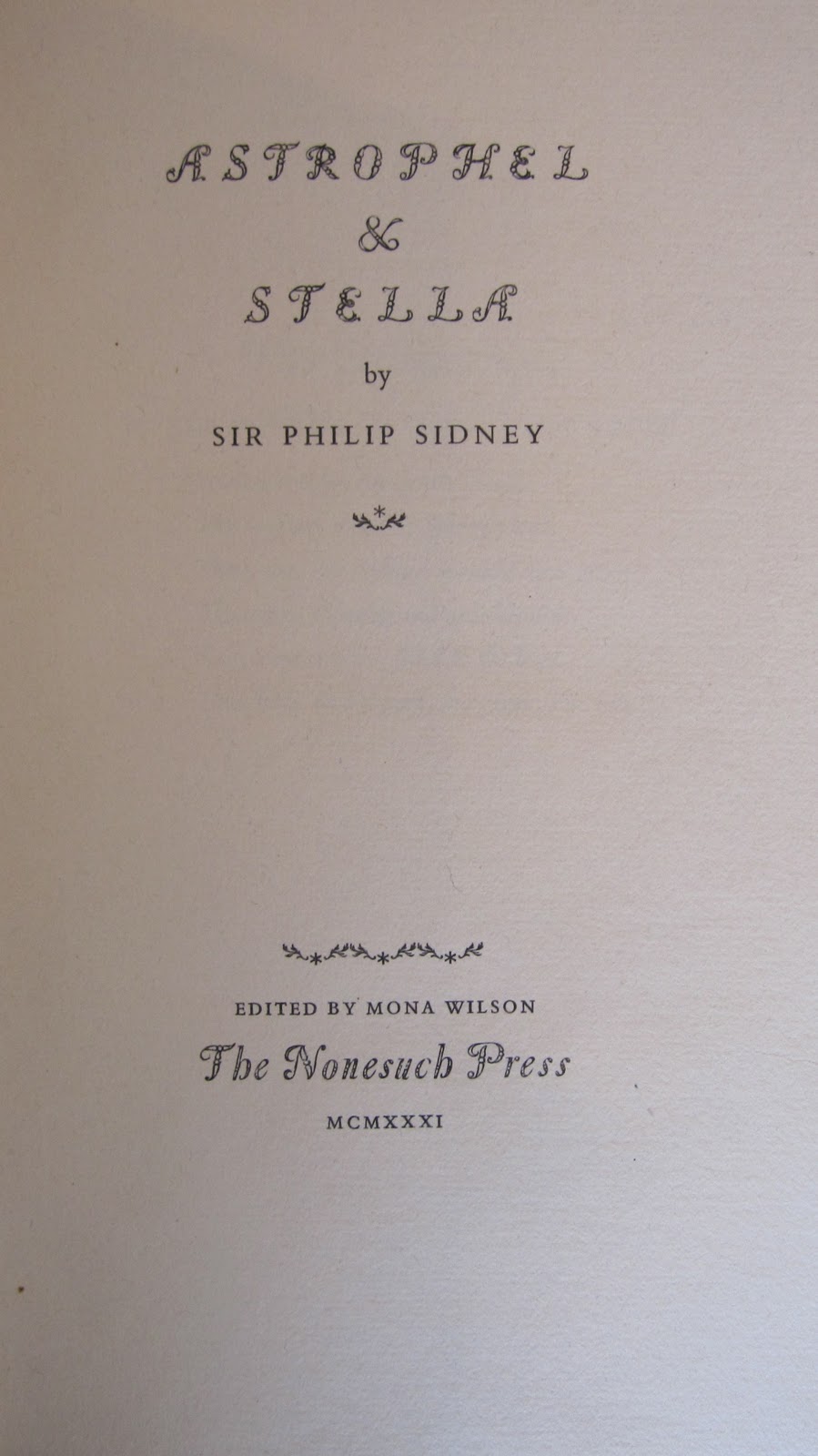
Astrophel and Stella, ed. Mona Wilson (London, 1931)
  
Astrophel et Stella, ed. Michel Poirier (Paris, 1957)

Not all of our rare books are all that old. Our interesting collection of books annotated by twentieth-century Renaissance scholars—including those donated by Samuel Schoenbaum and the historian J.H. Hexter—are absolutely unique, one-of-a-kind items, many of which reveal the genesis of important scholarly work; for example (and I will probably blog about this one day), we own Samuel Schoenbaum's copiously annotated copy of Alfred Harbage's Annals of English Drama, a book updated by Schoenbaum in a revised edition of 1966.

In today's entry I discuss our most important collection of books annotated by a famous scholar, the editions of Sir Philip Sidney's poetry formerly owned by William A. Ringler, Jr. These books are important not only because the extensive annotations help us understand how Ringler thought and worked, but also because he used these books to prepare and establish the texts of Sidney's poetry for his 1962 edition. For the rest of this entry I will investigate the case of Sidney's famous sonnet sequence Astrophel and Stella, with an eye towards understanding how Ringler used book-annotation to prepare his edition.

According to his textual notes on Astrophel and Stella in the Clarendon Poems (457), Ringler checked six different modern editions in the process of preparing his new text: Grosart (1873), Pollard (1888), Flügel (1889), Feuillerat (1922), Wilson (1930) and Poirier (1957). We own Ringler's annotated copies of all these books save the Flügel. The books contain a range of manuscript annotations, almost all of which are directly related to the textual history of Astrophel and Stella. For some of these Ringler used a system of color-coded annotations (referenced in the image above) to record variant readings in different textual witnesses. The abbreviations seen in these books ("13" "98") are the same he uses in the Poems.

Title Page to Grosart's edition (1877)
Grosart based his text on the 1613 quarto, even though he claims he used the more accurate 1598 in his introduction (Ringler 457). At the bottom of this page, Ringler notes "spelling indicates G really makes 1613 his copy text." The rubricated "red='98" at the top of the page, along with the rubricated corrections, demonstrate Ringler adding variants from the 1598 folio edition of Arcadia, which he describes as "the obvious choice for a copy text" (456). This is one of the more lightly annotated of Ringler's books.

Upper cover, Pollard's edition (1888)
Title Page, Pollard's edition (1888)
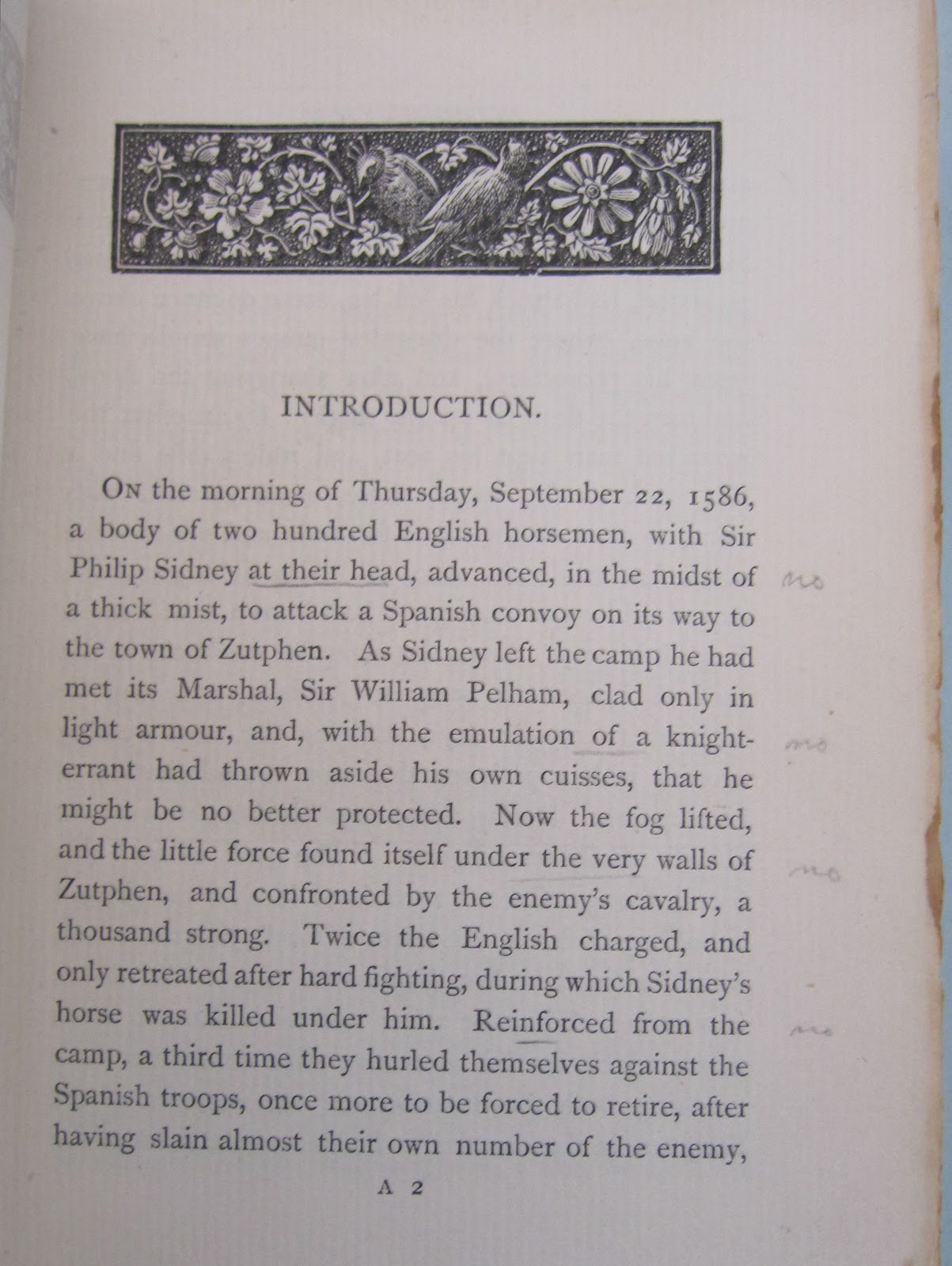
A.W. Pollard, on the other hand, produced "the most conservative and also the best of all the earlier editions" (Ringler 457), partially evinced by the copy's minimal amount of manuscript annotation. To aspects of Pollard's introduction, however, Ringler took exception, especially on several points of Sidney's biography. The four "no"s penciled in the margins (see image above) react to various inaccuracies related the Battle of Zutphen (1586), the event at which Sidney was mortally wounded.
Title page, Feuillerat's edition (1922)
MS notes from Ringler's copy of Feuillerat

If Pollard prepared the best text of the "earlier editions," Albert Feuillerat may have produced the worst. Apparently Feuillerat followed his immediate predecessor (Flügel 1889) in making very poor editorial decisions. Ringler summarizes the situation: "Flügel provided an unhappily inaccurate reprint of Q1, which he wrongly assumed represented the earliest state of Sidney's text...In 1922 Feuillerat, unfortunately following Flügel's mistaken notion of the textual relationships, printed a diplomatic transcript of Q1 with appended variant readings from Bt, Q2, 98, and all subsequent folios, but he provided no analysis of the significance of his variants" (457).

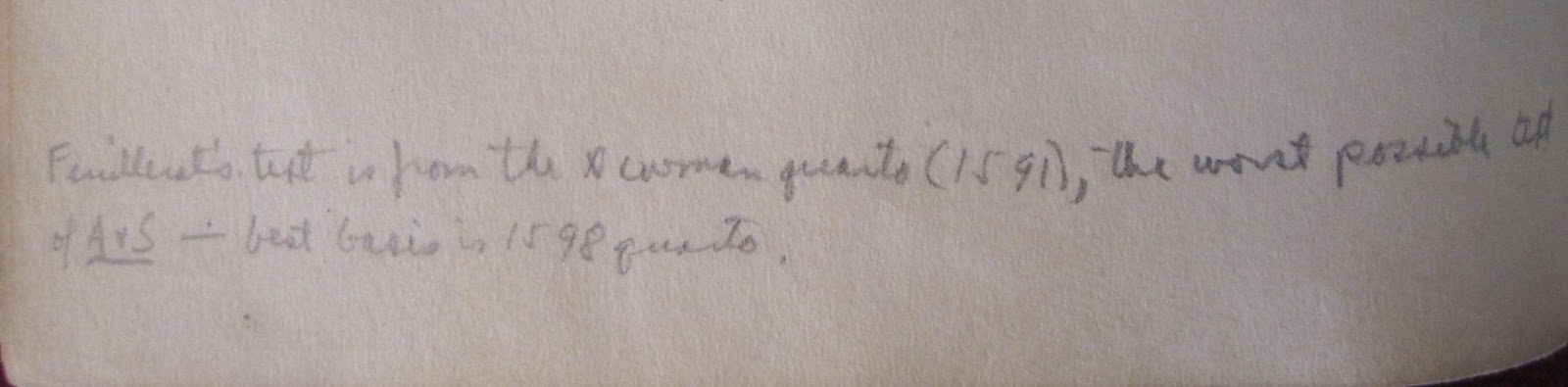
As one can see from the images, Ringler's copy of Feuillerat is the most copiously annotated book from his collection of Astrophel and Stella editions. According to the manuscript note above (last image; taken from page facing the beginning of Astrophel and Stella), "Feuillerat's text is from the Newman quarto (1591) [Q1], the worst possible text of A+S—best basis is 1598 quarto" (I think he means the 1598 folio here, but he could refer to Q3 of A & S, printed [1597-1600]). It is interesting to compare the content and tenor of this MS note to the section quoted above from the 1962 Poems (both of which serve similar evaluative functions); words like "unhappily" and "unfortunately" come off slightly less harsh than the MS "worst possible text."

According to Ringler's color-coded key, the annotations record corrections from Q1 (Feuillerat's copy-text), and variants from Q2, Q3, and "Bt," or, the "Bright Manuscript" (British Library MS Add. 15232). Ringler clearly used his copy of Feuillerat's edition to death, considering the poor state of the binding (see below). 

Mona Wilson's 1930 edition is "based on 98, with 53 emendations from Q1 and Q2" (Ringler 457). Although she wrote a "useful" introduction, Ringler doesn't approve of her "eclectic" method, "her text [being] less close to Sidney's original than Pollard's" (ibid).


This time without using his typical color-coded system, Ringler notes a number of textual variants in his manuscript marginalia.

Finally, our least annotated but perhaps most personal of Ringler's Astrophel and Stella copies is the French edition prepared in 1957 by Michel Poirier, whose gift inscription to Ringler appears on the half-title.

"To Professor William A. Ringler, with all my best wishes for the completion of his own edition of Sidney's poems. Michel Poirier. December 1957"—a pleasant sentiment, from one Sidney editor to another.

The intellectual labor Ringler invested into these manuscript notes translated directly into his most enduring scholarly work,  the monumental Poems of Sir Philip Sidney. This edition offers an admirable model for any serious editor, and to this day—nearly fifty years after its publication—it remains the standard text of Sidney's poems.