Friday, October 22, 2010

Reactionary Manuscript Annotation

marginal note, p.1

Walter Travers, A full and plaine declaration of ecclesiasticall discipline owt off the word off God, and off the declininge off the churche off England from the same. [Heidelberg]: Imprinted [by Michael Schirat], M.D.LXXIIII. [1574]. STC 24184. 4to. Later half-calf binding with marbled boards.

Polemical religious texts of the period were frequent targets of dismissive, combative, or outright hostile manuscript marginalia. William Sherman investigates this fascinating material practice through an annotated copy of Cardinal Allen’s True, sincere, and modest Defense of English Catholiques (1584), formerly owned by Richard Topcliffe, the Queen’s torturer (Used Books, xvii-xx). While not as offensive as a public defense of English Catholicism, the Ecclesiasticae disciplinae et Anglicanae ecclesiae ab illa aberrationis, plena e verbo Dei, et dilucida explicatio of Walter Travers (a Cambridge-educated English puritan living in Geneva) prompted much criticism from mainstream Anglicans. Published anonymously at Heidelberg in both Latin and English versions, the book espoused a Presbyterian model of church government, which replaced clerical hierarchy with a four-fold ministry of pastors, doctors, elders, and deacons. In applying this model to the Anglican Church, Travers argued against the administrative role of the diocesan episcopate, claiming that the model church in the New Testament presented bishops not as figures of “authority over other clergy, but merely ministers of local congregations” (DNB).

An early reader of the Center’s copy clearly took exception to Travers’ attack on episcopacy, as evinced in a number of reactive manuscript notes. The first, written in response to a sub-title on pg. 1 (“Necessitye off Disciplyne”) and firmly supportive of orthodox English views, reads: “Our State deny it not.”


marginal note, p. 7
A second, lengthier manuscript annotation continues the argument between reader and text, again espousing the orthodox views of the Anglican Church (due to the trimmed margins this is only an approximate transcription):

“we graunt it...certaine yet so...as that liberty is left to nursing [the]...ffaltse [?], & moths...of ye Church t...dispose of man...externall and...indiferent things...according to the...nature age quality & other circum-stances to be con-sidered in ther Child one, state for Hoc [?] omnia omnibus [all things for all people] et semper conveniunt [they always agree] . with this caueat of Pawle. omnia s[....] ant ordine, et a-edificationem, et charitatem conseruandam” (7).

marginal note, p.19

Some of the manuscript notes cite Latin or Biblical authorities, while others clearly voice the reader’s informed personal opinion on the matter. Take this example from p. 19 for instance:

“this also is gran-ted wherfore we haue degrees in vniuersities; [struckthrough] & orders from Bishopes with-out which it is not lawfull for any to take vppon him the ministry. And if th[er] be as euer ther w[ere] faltes committed in this as in all causes it is Personarum not Legum error et peccatum [an error and sin of persons not of law]” (pg. 19; shown here).


marginal note, p.23

A note appearing later in the book, “They are not allow[ed] in the practise of our Church,” responds to a point in the printed text criticizing English “women and midwives” who “take vpon them that parte off the office off the minister To baptize children in case off daunger off their lives.”

This copy of Travers' Full and Plaine Declaration presents a case of readers engaging directly with the ideas of a book through material practices. When readers annotate to "take notes" (as an aide memoire, indexical technique, or method of digesting knowledge), they typically enhance the accessibility of knowledge within the book: it is understood that the book is worth reading, annotating, and digesting, and the notes help to streamline this process. But when readers annotate to disagree, especially when the book in question contains political or religious polemic, they create a sort of "anti-text" in which  manuscript notes consistently undermine the argumentative bent of the printed work. In annotated books on theology such as this one, the back-and-forth argument between printed text and manuscript annotations approximates the discursive practices of the religious polemical dialogue: one side asserts a point, the other side disagrees, the one replies, the other replies to that reply. The biggest difference with the annotated book, of course, is the fact this dialogue is not a dynamic one. Because Travers is not physically present to address the annotator's theological issues, the annotator can continue his argument indefinitely by adding more and more notes without having to consider counterarguments or other developments in the debate: his opponent's position will always remain static, fixed within the print on the page.


John Johnson (1662-1725), LinkThe clergy-man’s vade-mecum, or, An account of the ancient and present Church of England; the duties and rights of the clergy; and of their privileges and hardships : containing full directions relating to ordination, institution, induction, and most of the difficulties which they commonly meet with in the discharge of their office. 

London : Printed for John Nicholson, Robert Knaplock, and Samuel Ballard, in Little-Britain and St. Paul’s Church-yard, 1715. 

[24], 362, [34] p. ; 16 cm. (12mo).

Renaissance Center copy is in contemporary calf (hinges cracked); in phase box; pencil signature of Will: Laurence dated June 11: 1718 on rear free endpaper (handwriting is questionable as to date); signature "Ed. Griffin. 1751" on rear pastedown; name and date repeated on front pastedown (with addition "Rector of Dingley"), but in the same hand that signs "Edward Griffin - nepos praedicti - Rector of Stoke Albany; extensive ms. marginalia. 1851." 


 This book was first printed in 1708 intended as a manual for members of the English clergy. It outlines various responsibilities and points of information pertaining to clerical life, including chapters on ecclesiastical hierarchy, “pluralities and dispensations,” and the “privileges and hardships of the clergy.”

ownership inscriptions
According to its ownership inscriptions, an Edward Griffin, rector of Dingley, Northamptonshire, owned the book in the middle of the eighteenth century. Rev. Griffin’s annotations suggest he was very concerned with the various responsibilities he held as rector, particularly with those related to the sound management and care of the property. For instance, he took a series of notes on the book’s endpapers referencing sections of the text dealing with the fate of old surplices and other church goods, especially the potential legal ramifications of their improper disposal.

"What if there be no C.Yard?"

In this image Griffin directly replies to the instructions and recommendations found in his clerical manual. Here the text suggests that services be held in a church-yard if the actual building has “fall’n down.” Griffin’s reply at the bottom of the page—“What if there be no C.yard?”—reflects its owner’s doubting and slightly anxious reaction to the book’s instructions. Unless Griffin was just an overly skeptical man, it seems likely that the Church at Dingley was in some state of disrepair, and that it decidedly lacked a church-yard.

"'Two are chosen to serve’ etc. by whom?”

This image contains similarly consternated manuscript reactions to the text. The text discusses the process through which proctors were chosen in dioceses containing multiple archdeaconries. Griffin is clearly confused by the fact that the book doesn’t specify who chooses these proctors: “Two are chosen to serve’ etc. by whom?” The forceful underlining amplifies Griffin’s negative reaction to the text’s imprecise wording and incomplete instructions.

Once again, it is clear the anxiety, frustration, and anger conveyed in these reactionary manuscript notes met with no immediate redress; after all, the book cannot respond to the critical questions its annotator has posed to it. At the same time, the annotations reveal some aspects of Edward Griffin's character: he is clearly a curious and thoughtful man who cares deeply about the welfare of his parish. At least for me, the annotations rouse an amusing sense of pity. Here we have a printed book intended as a handy "how-to" guide for English clergymen, printed in numerous editions throughout the eighteenth century to meet a seemingly large demand for the text. But for Edward Griffin out in Dingley, Northamptonshire (current population of 209)—in a parish apparently dealing with a church in disrepair—the manual simply did not fit the bill. Was the book popular? Yes. Was it in high demand among the English clergy? Probably. Was it useful for Griffin? Evidently not. For him, regardless of the book's utility on a number of topics, it was severely short-sighted on some of the issues he and his parishioners cared most about.


Saturday, October 16, 2010

Packaging a Restoration Play Quarto for the Eighteenth-Century Book Trade

Title Page
John Dennis (1657-1734),
A plot, and no plot : a comedy, as it is acted at the Theatre-Royal, in Drury-Lane / written by Mr. Dennis.
London : Printed for R. Parker, at the Sign of the Unicorn under the Royal Exchange in Cornhil: P. Buck, at the Sign of the Temple, near the Inner Temple Gate, Fleetstreet: and R. Wellington, at the Lute in St. Paul's Churchyard,  [1697].
[8], 79, [1] p. ; 21 cm. (4to).
RECENTLY ACQUIRED AND CATALOGED

In most cases I wouldn't get too excited about a Restoration play quarto, especially this one, since it isn't that rare (ESTC lists 38 copies) and the play itself isn't that good (I doubt John Dennis will make it into the Arden Early Modern Drama series). I like the paradoxical title, because it was probably inspired by Beaumont and Fletcher's tragicomedy A King and No King (1619), which enjoyed a considerable vogue during the Restoration. The author is also interesting in his own right. John Dennis was better known as a literary critic than a dramatist, and in a piece of travel writing he recorded an early articulation of the aesthetic concept of the "sublime" that would become famous in the works of Edmund Burke and Samuel Taylor Coleridge. His career in the theater was not a success, although one of his failed performances occasioned his coining of the phrase "to steal one's thunder." Dennis had invented a new way to make thunder for theatrical performance, but since his play flopped, he didn't get much use out of the innovation. When a performance of Macbeth used the same thunder a few nights later, Dennis claimed they "stole his thunder."

In any case, what interests me about this book is not its contribution to the history of dramatic literature, but its material form, especially what that material form may reveal about the market for drama in the early English book trade. Unlike most extant play quartos one can find in research libraries today, this particular play has not been rebound. Not only does the quarto bear remnants of its early stab-stitched binding, it also contains the front cover of a nearly contemporary blue paper wrapper. Throughout the hand-press period (and even today) pamphlets and other examples of ephemeral literature are rarely seen bound into codex form (unless they were bound together with other items in a sammelband or nonce collection): a crude stab-stitching or stapling job has proven sufficient for cheap print over the centuries. But this isn't to say booksellers and binders didn't worry about protecting the printed contents of their pamphlets, because they did: they just used cheaper materials to do so. The paper wrapper, therefore, was widely used to create a pamphlet's "covers," and would have been the first defense between the printed text and the outside world. To state the obvious, these paper wrappers just don't survive that often.

recto of front wrapper

This particular paper wrapper has a number of unique qualities. First it must be noted the wrapper isn't contemporary with the printed pamphlet; that's not to say this piece of paper dates to the modern age, but the evidence suggests the wrapper was added about ninety years after the play was printed. I will delve into the details of this evidence in a moment, but for now what this ninety year gap between printing and packaging suggests is that the wrapper was not part of the pamphlet's original packaging, but part of a repackaging, probably for the second hand book trade. And we can can be fairly certain a bookseller (rather than a private or institutional owner) added the wrapper because it bears a few written and printed clues related to the trade. In what could very well be an eighteenth-century hand, a few manuscript notes on the wrapper's recto note the play's title ("Plot & no Plot"), its price ("1s"), and an unidentified number ("6764"), probably an inventory code of some kind. But the wrapper fragment's verso offers even stronger evidence that this is in fact a bookseller's wrapper.
 

verso of front wrapper: English book advertisement ca.1787

The wrapper fragment doubles as a piece of a broadside advertisement marketing a book published in the 1780s. The book in question is Ephraim Chamber's Cyclopedia (editions from 1728-1787), the first major English encyclopedia and a huge influence on important eighteenth-century writings such as Samuel Johnson's Dictionary and the Encyclopédie of Diderot and D'Alembert. The advertisement markets the book as the source of "information and improvement for mankind," noting its influence in France "where science hath been...cultivated and encouraged." The ad exists in only one full copy at the British Library, so it is an extremely rare piece of printed ephemera. The ESTC record (ESTC T14278) dates it to [1787?], probably because internal evidence refers to the 1753 Supplement of the Cyclopedia issued "some years ago." The record also contains a note identifying the bookseller responsible for the advertisement, a piece of text on the ad missing in the fragment shown here: "Communications may be addressed to the editor, Mr. Longman’s, bookseller..." The title page to the five-volume 1786-88 edition of the Cyclopedia lists a "T. Longman" as one of over a dozen booksellers authorized to sell the work.

This particular book seems to answer a few questions I have about the early English book trade. What could a play quarto have looked like on the stalls of a bookshop in the hand-press period? How were books packaged for the second-hand book trade? What sorts of materials did booksellers use and reuse to package their wares? Although the case of this book can only answer such questions for the eighteenth-century book trade, considering that the ad/wrapper dates to the hand-press period and that it is so rare for these book advertisements to survive, I think it is fair to say this copy of A Plot and no Plot could offer an approximate model for how plays were packaged and sold in earlier periods, perhaps even during Shakespeare's career. The book remarkably demonstrates the ephemeral nature of the play quarto in a number of ways; in this case, the ephemeral printed pamphlet is protected by an even more ephemeral piece of early advertising. The quarto also records an instance of booksellers reusing old advertisements to package their products, modeling a practice of material recycling that must have been vital for a trade in which raw materials were expensive. All things considered, modern readers and scholars may never read this play for its contributions to the history of dramatic literature, but its material form could very well help illuminate the history of the early English book trade and the market for early printed drama. 


Friday, October 8, 2010

"Tithes too hot to be Touched": A Seventeenth-Century Sammelband of Pro-Tithing Pamphlets

[Sammelband of English pamphlets in defense of tithing and episcopacy, 1637-1660]. 4to. Contemporary full calf binding. Each pamphlet labeled by a different letter of the Roman alphabet

A term first used to describe the combination of print and manuscript texts in late medieval European tract volumes, sammelband (Ger. “anthology”) has since been applied to “bound volume[s] containing a number of separately published pamphlets on a connected theme” (Oxford Companion to the Book). Collectors fashioned their sammelbände as custom anthologies to reflect a subject or theme of personal interest: one could collect Shakespearean drama, or pamphlets on the Northern Rebellion, for instance. Pragmatism equally governed the compilation of such collections, especially for practical or devotional texts. Wealthier readers could purchase an entire year’s worth of different almanacs and bind them together to create a single, convenient reference manual. Speed’s genealogies and map of the Holy Land were frequently bound into compilations containing the Bible, Psalms, and Book of Common Prayer. The Center owns a number of sammelbände, many of which were probably compiled by nineteenth-century book collectors. These include several devotional books, a collection of William Prynne’s works, and a compilation of mid eighteenth-century French erotic novels. We have two sammelbände surviving in their contemporary bindings (the pro-tithes collection discussed below and a German philological handbook), both of which were probably compiled in the seventeenth century.

Title page to Tithes too hot to be Touched (1646)

The “Tithes Controversy” was one of the many hot-button religio-political issues of the 1640s and 50s that helped polarize Civil War England. Throughout the seventeenth century, popular support arose for the non-payment of tithes—an attack on the very idea of a state church. The problem with tithes stemmed from the rise of Separatist or "congregationlist" sentiments, in part from economic issues such as lay “impropriations,” that is, the collection of tithes by lay owners of ecclesiastical lands (tithes were expropriated to lay owners following the dissolution of the monasteries). Even pro-tithe spokesmen like Henry Spelman vilified lay impropriators who “imployed the church to prophane uses, and left the parishioners uncertainly provided of divine service.” In the more radical views of non-conformist groups like the Diggers, the abolition of tithes was bound up with the abolition of rents and private property, a notion voiced in a number of polemical pamphlets that undoubtedly put conservative landowners on edge. Ironically, backlash against impropriators in the form of non-payment of tithes left legitimate ministers without a means of living in some parishes. In turn, many wished to change the way ministers made a living, either through government stipends, voluntary parishioner contributions, or by putting ministers to work. Nonetheless, the laws largely stayed the same and the non-payment of tithes continued on unabated. If anti-tithing pamphlets galvanized this behavior, a number of writers sought to counteract it by waging pamphlet warfare of their own. (Special thanks to Professor Joseph L. Black for his comments on this section.)

Pamphlet "G" (#4)
Pamphlet "H" (#5)
Pamphlet "K" (#7)

The book shown here is a sammelband of English pamphlets in defense of tithing and episcopacy, two orthodox Anglican practices attacked by non-conformist religious groups during the Civil War. These pamphlets argue for the ancient precedent of tithing and its necessity for the monetary support of the Church, while at the same time dispelling the false characterizations of tithing disseminated in non-conformist pamphlets. Considering these texts alongside the collection’s pro-episcopal pamphlets, we can surmise that the compiler was an orthodox Anglican and probably a Royalist.


manicules and underlining, Pamphlet #15


manicule and marginal note, Pamphlet #15
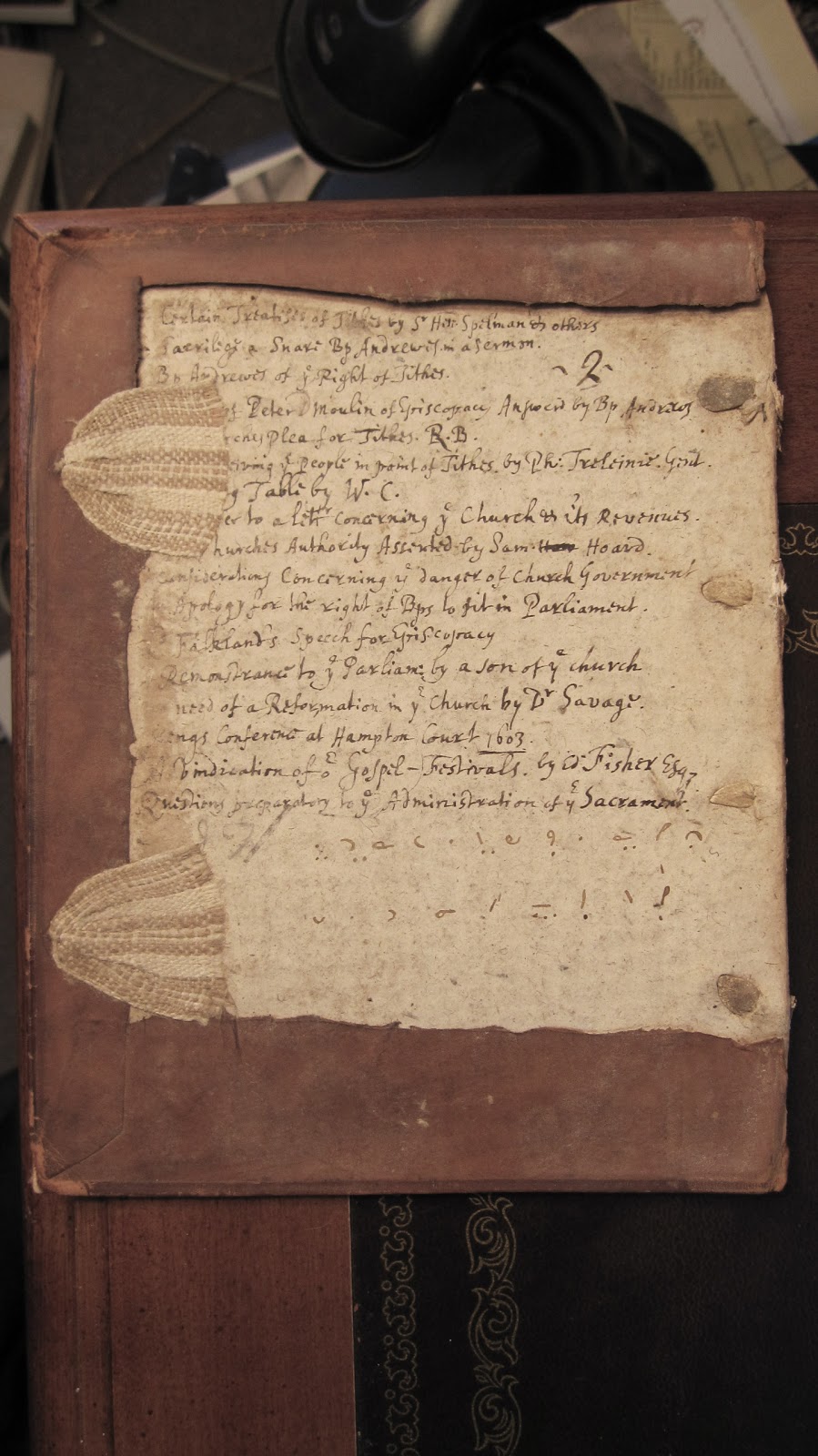
The book’s compiler added manicules and marginal notes to some of the pamphlets, especially William Barlow's Summe and Substance of the [Hampton Court] Conference (1638; pamphlet #15 below), with which he seemed to disagree. To organize the collection and create a quick reference tool, the owner also wrote out two different manuscript tables of contents (one on the inside front cover, the other on a loose endpaper) in which each text has been assigned a different letter of the alphabet. 

MS table of contents, inside front cover
MS table of contents, front endpaper

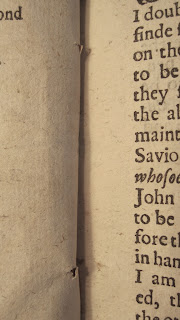
Each item has been rebound into the compilation's contemporary calf binding, but each bears the material signs of their earlier forms as stab-stitched pamphlets. You can still see the holes made through the paper for these crude bindings:

Stab-stitch holes that line up
Stab-stitch holes that don't line up
In the first image you can see that the holes line up perfectly, and so they should since this opening occurs in the middle of a pamphlet. But in the second image the holes don't line up, because the opening occurs between two different pamphlets, both of which were originally printed and bound for separate sale. By analyzing the number of stab-stitch holes and whether or not they line up, we can determine which pamphlets were originally bound together or sold separately. 

It is likely the owner purchased the pamphlets during the Civil War, and bound them together around the time of the Restoration. If this pattern of book purchasing and compilation is accurate, then we can characterize this sammelband as a retrospective collection of literature related to the Tithes Controversy, probably made by an Anglican apologist. A few of the pamphlets in the collection are exceedingly rare (#s 3 and 5 are one of four copies known worldwide, #s 10 and 14 unrecorded in Wing). 

 What follows is a list of the sammelband's pamphlets with the relevant bibliographical data:

List of Texts in the Pro-Tithes Sammelband
(with special thanks to John Lancaster for his admirable cataloging)

1.     Spelman, Henry. Tithes too hot to be touched: certain treatises, wherein is shewen that tithes are due : by the law of nature, Scripture, nations, therefore neither Jewish, popish, or incovenient / written by Sr. Henry Spelman knight and others ; with an alphabetical table.  London : Printed for Philemon Stephens, [1646]. Wing S4931. A,B,C,D.1
2.     Spelman, Henry. De non temerandis ecclesiis = Churches not to be violated : a tract of the rights and respects due unto churches : written to a gentleman who having an appropriate parsonage imployed the church to prophane uses, and left the parishioners uncertainly provided of divine service in a parish neere there adjoyning / vvritten and first published thirty years since by Sir Henry Spelman knight. Oxford: Printed by Henry Hall, 1646. Wing S4921. A,D.1
3.     Andrewes, Lancelot. Three learned, and seasonable discourses / by the Right Reverend Father in God Lancelot Andrews, Late Lord Bishop of Winchester ; translated for the benefit of the publike. [London? : s.n.], Printed in the yeer. 1647. Wing A3153A. D.2,E,F
4.     R. B. (Robert Boreman). The country-mans catechisme, or, The churches plea for tithes: wherein is plainely discovered, the duty and dignity of Christs ministers, and the peoples duty to them. London : Printed for R. Royston, 1652. Wing B3757. G
5.     Anonymous. A vindication of a short Treatise of tythes, lately written, and excepted against by a pamphlet, styled, The funeral of tythes, &c. London : Printed by T. Newcomb, for Thomas Heath, 1653. Wing V467. H
6.     Heylyn, Peter. The undeceiving of the people in the point of tithes : wherein is shewed : I. That never any clergy in the church of God hath been, or is maintained with lesse charge to the subject, then the established clergy of the Church of England : II. That there is no subject in the realme of England, who giveth any thing of his own, towards the maintenance of his parish-minister, but his Easter-offering : III. That the change of tithes into stipends, will bring greater trouble to the clergy, then is yet considered, and far lesse profit to the countrey, then is now pretended / by Ph. Treleinie, gent. London : Printed by J.G. for John Clark, 1651 [i.e. 1652]. Wing H1742. I
7.     Crashaw, William. Decimarum & oblationum tabula : a tything table, or, Table of tithes and oblations : according to the ecclesiastical laws and ordinances established in the Church of England, now newly reduced into a book : containing as well the very letter of the law under which these rights be severally comprised, together with such questions of tything, and their resolutions by the lawes canon, civil, and approved doctors opinion of the same, as be ordinarily moved, and which doe often prove to controversies herein : as also a brief and summarie declaration of composition, transaction, custom, prescription, priviledge, and how they prevail in tything : annexed hereunto summarily, such statute lawes of the land concerning these rights, as have been herein authorised, and now doe remain in their force accordingly : to the easie and plain instructions of all the subjects ecclesiastical of lay, whether in these rights to demand them, or bounden to perform the same. London: Printed by J. T[wyn] for Andrew Crook, 1658. Wing C148B. K
8.     Steward, Richard. An ansvver to a letter vvritten at Oxford, and superscribed to Dr. Samuel Turner, concerning the Church, and the revenues thereof : wherein is shewed, how impossible it is for the King with a good conscience to yeeld to the change of church-government by bishops, or to the alienating the lands of the Church. [London : s.n.], 1647. Wing S5516. L
9.     Hoard, Samuel. The churches authority asserted : in a sermon preached at Chelmsford, at the metropoliticall visitation of the most Reverend Father in God, VVilliam, Lord Arch-bishop of Canterbury his Grace, &c. March 1, 1636. London : Printed by M[iles] F[lesher] for John Clark, 1637. STC 13533. M
10.  Hammond, Henry. Considerations of present use concerning the danger resulting from the change of our church-government. London : [s.n.], 1644. ESTC R226831 (not in Wing). N.
11.  Stephens, Jeremiah. An apology for the ancient right and power of the bishops to sit and vote in parliaments as the first and principal of the three estates of the kingdome : as Lord Coke sheweth, 3. Institut. c.1. and other both learned lavvyers and antiquaries, as Camden, Spelman, Selden, and many others : with an answer to the reasons maintained by Dr. Burgesse and many others against the votes of bishops : a determination at Cambridge of the learned and Reverend Dr. Davenant B. of Salisbury, Englished : the speech in Parliament made by Dr. Williams L. Archbishop of York, in defence of the bishops : two speeches spoken in the House of Lords by the Lord Viscount Newarke, 1641. London : Printed by W. Godbid, for Richard Thrale, 1660. Wing S5446. O,P,Q
12.  Falkland, Lucius Cary, Viscount. A draught of a speech concerning episcopacy. Oxford : Printed by Leonard Lichfield, 1644. Wing F319. R
13.  Hall, Joseph. An humble remonstrance to the High Court of Parliament. London : Printed by M[iles] F[lesher] for Nathaniel Butter, 1640 [i.e. 1641]. STC 12675. S
14.  H. S. (Henry Savage). Reasons shewing that there is no need of such a reformation of the publique 1. doctrine : 2. worship : 3. rites & ceremonies : 4. church-government : 5. discipline : as is pretended by reasons offered to the serious consideration of this present Parliament, by divers ministers of sundry counties in England. London : Printed for Humphrey Robinson, 1660. ESTC R236863 (not in Wing). T
15.  Barlow, William. The summe and substance of the conference, which it pleased his excellent Majestie to have with the Lords Bishops, and others of his clergie (at which the most of the Lords of the Councell were present) in his Majesties privie-chamber at Hampton Court Inn. 14. 1603 / contracted by William Barlovv, Doctor of Divinity, and Deane of Chester ; whereunto are added some copies (scattered abroad) unsavory, and untrue. London : Printed by Iohn Norton, and are to bee sold by Ioshua Kirton and Thomas Warren, 1638. STC 1459. V
  1. Fisher, Edward. A Christian caveat to the old and new sabbatarians, or, A vindication of our Gospel-festivals : wherein is held forth, I. that the feast of Christs nativity is grounded upon the scriptures; was observed in the pure, ancient, apostolique times, and is approved by all reformed churches : II. that Christ was born on the 25 day of December; and all objections to the contrary refuted : III. that the keeping holy the Lords-Day was appointed by the Christian Church; and that the morality, and divine institution of the Lords-Day are meer fictions : IV. that the day of Christs nativity, the day of his passion, and the like, have equall authority, equall antiquity, equall right to be observed as the Lords Day; and that to work on those dayes is equally sinful : V. that the observation of the Sabbath Day is abolished in Christ; and that to call the Lords Day the Sabbath, is sensless, Jewish, unchristian, unwarrantable : together with questions preparatory to the better, free, and more Christian administration of the Lords supper. London : Printed for Edw. Blackmore and R. Lowndes, 1655. Wing F992. W


Wednesday, September 29, 2010

Doodling in a Copy of Guarini's "Il Pastor Fido"

frontispiece and title page
Battista Guarini, Il Pastor Fido=The Faithful Shepherd: a pastorall / written in Italian by Baptista Gvarini, a knight of Italie ; and now newly translated out of the originall. 
London : Printed by R. Raworth, M DC XLVII [1647].
[12], 223 p. : ill., port. ; 20 cm.
Translated by Richard Fanshawe.

Renaissance Center copy is in later (18th-century?; a signature dated 1660 is partially trimmed) calf (rebacked; inner hinges cracked; all before B2 and 2F2-4 detached; some worm damage to outer margins, which occurred before the current binding); extensive scribblings on several leaves at front and at back, including drawings and names, presumably of owners: John Penrose (title page; dated both 1647 and 1660); Bernard Penrose (2F4v; dated 1704; and on V3v and X4v, undated); Thomas Penrose (front free endpaper; and V1v, dated 1701; and 2F4v, dated 1708); Francis Penrose ((a)2v, undated; and as "Frank Penrose" on M2r, undated); Edward Penrose (F3r and 2F4v; undated); Margarett Penrose, James Lake, and Robert Olivier (all 2F4v, undated); John James Sampson (2E4v; undated). 
 
Although a number of my posts on early modern manuscript annotation characterize the practice as a serious affair, practiced by diligent scholars or readers deeply invested in their reading material, one can't ignore the frivolous act of doodling as one of the most common forms of book annotation. Children and bored students (both in the early modern and modern periods) frequently doodled in the blank leaves of their books, both as a form of writing practice ("pen trials") and no doubt to alleviate the boredom of tedious classroom lessons.

The subject of this post is the most copiously doodled book in our collection, a 1647 English translation of Guarini's Il Pastor Fido. The play is well known as one of the first tragicomedies ever written and its author's writings on the genre influenced a number of early seventeenth-century English playwrights. Beaumont and Fletcher's plays Philaster and The Faithful Shepherdess are both indebted to Guarini's experimentation with tragicomedy.

But this post isn't about tragicomedy, it's about doodling, copious doodling. This particular copy's title page and frontispiece (in addition to the blank recto of the frontispiece leaf) bear a complex layering of pen trials, drawings, tracings, signatures, and sums, stemming from the ownership of nine different people in the seventeenth and eighteenth centuries (many of them from the Penrose family).

 Let's begin with the frontispiece leaf:

recto of frontispiece leaf
Perhaps the most obvious items of note on this page are the amateurish drawings, one of which is clearly a tracing of the frontispiece on the other side of the leaf. Probably in imitation of the fairly decent tracing job, a second would-be artist (undoubtedly a child) has added a second rendition of Guarini's face, upon which a third illustrated figure leans. A number of pen trials and other forms of handwriting practice litter the page, including the strange, owl-like forms in the bottom left-hand corner, clearly intended to train writing students in the formation of specific pen strokes. The page also contains (in no particular order) sums, transcriptions of the book's title, an armorial drawing, the initials of Baptista Guarini, and a line from an unidentified text.

frontispiece
Of course the frontispiece itself supplied the image for the tracing, and in its margin another annotator has drawn a couple fairly accurate human heads.

detail of margin on frontispiece leaf: drawings of heads
The title page contains a number of different sorts of doodles, including many items seen on the reverse page (a transcription of the book's title and another armorial drawing, for instance). The amateur drawing also continues with several images of birds and wings, apparently drawn by the same person responsible for the human figure on the reverse side of the leaf. One of the title page annotators has copied "London" from the book's imprint, writing it in both English and Latin. Another has written a number of early capital "block" letters (several "B"s, and "E," and an "H").

title page
There are also plenty of signatures on the title page and elsewhere in the book, identifying a total of nine different owners or readers from various time periods. One of the most interesting ownership marks elects not to use the typical signature for self-identification, but instead the rebus, that strange admixture of words, letters, and images we usually associate with children's literature.

detail of ownership rebus


As part of the witty, playful, and sometimes secretive literary culture of the day, writers could adopt the rebus as a way not only to mask their identities, but also to playfully incorporate text and image into the presentation of their names. If you haven't already figured it out, this rebus reads "T [Pen] [Rose]," or Thomas Penrose, one of the many owners identified elsewhere in the book. The rebus incorporates the Tudor Rose into an interesting amalgam of local (the Penrose family) and national identity, and I suspect its form was passed down through the family for some time. The illustration of the pen drawing the rose, albeit clearly appropriate for someone named "Penrose," is also interesting in light of the many drawings and pen marks displayed in this book, since it depicts the very material processes responsible for the doodling. Along with my earlier post on children's annotation, this example clearly demonstrates a relationship between the book and reader based less on serious intellectual engagement than on casual and playful interaction with a material object.

Friday, September 10, 2010

Commonplacing and Binding Practices in a Sixteenth-Century Estienne Dictionary

This post (as well as several more to come in the near future) corresponds to the Center's rare book exhibit for Fall 2010, "The Living Library: Books and their Owners in Early Modern Europe." The exhibit highlights evidence for different reading and ownership practices in our collection of early printed books, including the prize inscription, the sammelband, provenance, and printed paratexts. If you're in the Amherst, MA area, feel free to stop by and see the exhibit, and if you can't I hope these posts capture the essence of the physical display.

Front hinge
Rear hinge


Upper cover


Lower Cover
Robert Estienne, Dictionarium nominum propriorum uirorum, mulierum, populorum, idolorum, urbium, fluuiorum, montium, caeterorumq[ue] locorum, quae passim apud melioris notae auctores leguntur : liber longè auctior, quàm is qui elucidarius poëticus uulgò inscribitur, ad intelligendos poëtas, oratores, ac historiographos non solùm utilis, uerùm etiam necessarius à multis quibus antea scatebat, uicijs repurgatus. [Cologne: Printed by Walter Fabritius, 1558]. 8vo. Contemporary blind-stamped full calf binding.

The scholar and printer Robert Estienne (1503-1559; Latin surname "Stephanus") prepared a number of important books during his career, including the Dictionarium latinogallicum (1552) and Dictionarium seu linguae latinae thesaurus (1531), in addition to landmark editions of the Hebrew Bible and Greek New Testament. This copy of his “Dictionary of Proper Names” (we also own a 1575 edition) survives fully intact in a remarkable contemporary binding; an early owner, almost certainly from England, bound the dictionary in modestly decorated calf leather, using two old manuscript scraps for the book’s endpapers.

Recto of front MS endpaper
Verse of front MS endpaper

Recto of rear MS endpaper
Verso of rear MS endpaper
Although the texts represented in the vellum scraps have yet to be identified, we can be relatively certain about their languages, scripts, and approximate dates (front endpaper: Latin, bastarda anglicana, c. xiii-xiv sec; rear endpaper: English and Latin, fifteenth-century English secretary hand). As is common with early books surviving in contemporary bindings, the dictionary’s endpapers bear ownership inscriptions, pen trials, and manuscript notes from several different owners.

Inscriptions on front endpaper
 The latest to leave a mark was “C. Aston 1847.” A “Francis Fisher” (writing in a late sixteenth or early seventeenth-century secretary hand) signs the book three different times, once with the Latin motto tu decus omne tuis (“you the sole glory of your kindred”). His relation Robert Fisher signed the book with a Latin inscription in the 1650s.

Title page inscriptions
Title page signatures record the names of “Ro: Gaton” and (in a sixteenth-century secretary hand) William Brabin (probably the earliest owner); according to the note, Brabin purchased the book for 2s 3d.

MS miscellany of commonplaces on endpaper, in the hand of William Brabin
He used the endpapers as a manuscript miscellany, recording Latin commonplaces from Plato, Erasmus (from Adagia III.ii.36), Ovid (Tristia IV.x.3-4), and Marc Antony, in addition to a recipe (containing urine and eggs) and the proverb tempura mutantur et nos mutamur ab illis (“times change and we change with them”). Here is a transcription (with some translations) of a few of the notes:

Plato:

plato de xenocrate dixit venere dicendi carebat. idem de Iamblico dicatus. 

Erasmus:

Kesos [in Greek] d[?]cn pictus cestus.2: cingulum veneris, efficax ad illectamentum gratiarum et Amorum, quo illa dicitur martem conciliare: Erasmus cestum habet veneris: [Adagia III.ii.36] /

Ovid

Ovides de se Pelignae gentis gloria dicar ego / Sulmo [Sulmona] est metropolis pelignorum vnde ovidius Sulmo mihi patria est gelidis vberrimus vndis millia qui novies distat ab vrbe decens. [Ovid, Tristia IV.x.3-4: “Sulmo’s my native place, rich in icy streams, and ninety miles distant from the City.”]

Marcus Antony:

Marcus Antonius / Huius viri illud inprimis admirabile dicitur, quod in otio Luxuriosissimus in negotio Laboriosissimus fuit [listed as a commonplace in Calepinus Dictionarium, 1576]         

Last item:

tempura mutantur et nos mutamur ab illis [Times change and we change with them: possibly Lothair I of the Holy Roman Empire (795-855)]


another commonplace [duplication of Ovid passage], with pen trials
The owners used another rear endpaper chiefly for handwriting practice, as evinced by the scribbled red stars, numerous strokes for majuscule “E,” and the words “De Anima” in an amateurish italic hand. The Center also owns several books printed by the Estienne family, including Robert’s fourth edition of the vulgate Gospels (1545), Polydore Vergil’s De inuentoribus rerum (1529), and an edition of Erasmus’s Adagia (1558), in addition to his son Henry’s editions of Plato’s Opera omnia (1578) and Maximus of Tyre’s Dissertationes (1557).

Estienne printer's device, from Erasmus Adagia (1558)
Here is the "Scribd" digitized document of these images:

Estienne Dictionarium 1558                                                            

Monday, August 30, 2010

Continental Book Ownership I

Prize Inscription

Daniel van Papenbroeck, Responsio Danielis Papenbrochii ex Societate Jesu theologi ad Exhibitionem errour per Adm R.P. Sebastianum a S. Paulo, ordinis Carmelitani in Belgio bis Provincialem, olim sacrae theologiae professorem Lovanii, evulgatam anno MDCXCIII Coloniae : pars prima ad XII priores articulos.
Antwerp: Hendrik Thieullier, 1696. [2], 2 leaves, 3-318 [i.e. 320], [10] p., 1 leaf of plates : ill., port. ; 23 cm. (4to). Contemporary (?) marbled boards, spine repaired with brown cloth.

This book’s front pastedown offers an example of a prize inscription, a handwritten congratulatory dedication accompanying a rewarded book and often combined with a unique prize binding. Presenting a theological work by the Jesuit Bollandist Daniel van Papenbroeck (1628-1714) to a Hubertus Eelkens of Antwerp, the inscription commemorates and praises the student’s performance in syntax, a class of study commonly offered in Catholic secondary schools and colleges. A note at the end of the inscription illuminates the educational context in which this prize was awarded: “our Turnhout gymnasium” refers to an elite secondary grammar school in Oud-Turnhout, Belgium. While I haven’t been able to identify the exact school (if it still exists), the remainder of the note indicates it was directed by an “R.R. D.D. Can. Reg. de Corssendoncq.” The identity of “R.R.” may remain a mystery at the moment, but the titles accompanying the initials indicate his educational experience (Doctor of Divinity) and devotional affiliation (Canon Regular of St. Augustine, in residence at the Corsendonk Priory). This information places the presentation of the prize book within a specific educational context, one in which Augustinian canons taught secondary-school students syntax and related subjects (such as grammar and rhetoric). As befitting the pomp of the occasion, the majority of the inscription is comprised of a panegyric Latin poem, one praising the virtues of piety and wisdom: 

Palladis ingenuus laudatur ab omnibus ast is

laudandus magis est, qui pietate viget:

Nam recta pietate potens, lætatur utroque

nam pius est doctus quærere regna dei;

Ergo pius doctusque simul, tantummodo docto

præfertur, quoniam solus utrumque tenet.


Other marks of provenance in the book link its ownership to a number of Dutch Jesuit theological libraries in Maastricht, Netherlands.


Ausonius van Popma, Ausonii Popmae, Frisii: De differentiis verborum, libri IV. et De usu antiquae locutionis, libri duo / nunc primum in Germania Magno juventutis bono editi, curante Bartholomaeo Musculo, JC [Hesse, Germany: Josephus Dietericus Hampelius, 1660]

Isocrates, Isocratis Orationes tres : I. ad Demonicum. II. ad Nicoclem. III. Nicocles : cum Plutarchi Chaeronei Paedagogia, seu, De liberorum institutione libello, è graeco in latinum verbotenus in gratiam tyronum linguae graecae translatae, prioribus multò emendatiores : quibus accesserunt Pythagorae Carmina aurea, & Phocylidis Pöema admonitorium, cum versione Michaelis Neandri [Jena, Germany: printed by Kaspar Freyschmidt at the expense of Martin Müller, 1659]
8vo. Contemporary vellum binding. 

A seventeenth-century German owner bound these two texts together and added a detailed index to create a customized philological handbook. Entitled “Index vocum omnium, quarum hoc libro differentiae traduntur” (“Index of all the words, the differences of which in this book are related”), the index was designed to supplement the grammarian and philologist Ausonius van Popma’s De differentiis verborum, a landmark book on synonyms frequently reprinted in the seventeenth century. Its title page has an inscription (dated 1667) most likely belonging to the index-maker and book owner, Johann Betichius of Zerbst-Anhaltini, Germany. This is probably the hymn writer Johann Betichius (1650-1722), who studied theology at the University of Wittenberg (1666-1670s) before serving as pastor of the Trinity Church in Zerbst (from 1689). 


The index and De differentiis verborum are bound with an edition of Isocrates’ (426-338 BCE) orations, a book also containing Phocylides’ Poema admonitorium, the Carmina aurea attributed to Pythagoras, and Pseudo-Plutarch’s De liberis educandis. If the identification of the owner is correct, Betichius acquired these books, bound them, and wrote the index during his academic career. Taken all together, this book demonstrates the academic function of the sammelband as textbook in the educational context of the seventeenth-century German university.